‡ Anthroposofie ‡
Anhang Peter Morell
Nutrition: Summary of Lectures:
Vergleich Anthroposofisch Pflanze, Tier, Mensch
http://wiki.anthroposophie.net/Wesensglieder
WALA, an organic/biodynamic pharmacy based in
"Dem Stoff sich verschreiben heißt Seelen zerreiben
Im Geiste sich finden heißt Menschen verbinden
Im Geist sich schauen heißt Welten erbauen." (R.S.)
R.S.: Rind und Löwe geformt durch Kräfte aus der Erde (Astral- = Seelenleib).
Vögel und Reptilien geformt durch Kräfte aus dem kosmischen Weltenraum (Äther- = Lebenskraftleib).
Anthroposophical Medicine
The philosophy of anthroposophy is a valuable tool when choosing an
accurate remedy. Plant, mineral or animal parts can be likened to human bodily
systems making it easier for the homoeopath to see the simillimum (Steiner,
1861 – 1925).
Anthroposophical medicine is often classed among natural or other kinds
of alternative medicine, or it is equated with herbal medicine or homoeopathy.
It is seen as an extension of medical practice on the basis of the
comprehensive view of the human being provided by spiritual science. Rudolph
Steiner (1861 – 1925) describes anthroposophy as seeking to unite the spiritual
element in the human being with the spiritual element in the universe (and
therefore nature). He states that all natural objects have a fundamental
relationship to the essential human being, and every aspect of the complex
human organisation has its „counterpart‟ in nature (Steiner, 1861 - 1925).
Man has the whole of the natural world within him, nature is an infinitely
differentiated human being (
From the anthroposophical point of view the human being is an entity
formed by spirit, soul and body.
According to this spiritual science man has three members of his being:
the nerve-sense system, the metabolic-limb system, and the rhythmic system.
A harmonious balance of these three systems keeps man in a general state
of health. The nerve-sense system has its origin in the head sending its
processes to the fingers and toes. Within the head is a cool and quiet
environment, where thought and memory are possible. The nerve-sense system
receives and analyses information, and rest is essential for this system to
function optimally. This system is made up of nerve cells, which are cells that
do not have the capacity to regenerate themselves throughout life. Diseases
that affect the nerve-sense system are „cooling‟, catabolic, and hardening (
The opposite pole is in the digestive area and is known as the
metabolic-limb system. This is an area much warmer than the head and an area of
constant activity (metabolism). The cells representing this system are
constantly undergoing death and regeneration, and in the lower region of this
system man reproduces his own kind (the genitals). These are unconscious
processes. Activity of this system is involved with conscious and unconscious
movement of the limbs, as well as metabolic processes. Diseases affecting the
metabolic-limb system are „hot‟, for example fever and inflammation.
These two opposite poles are joined by the rhythmic system. Without the
rhythmic system the polar opposites would not maintain a harmonious balance.
For example, circulation relates to the metabolic-limb system, whilst breathing
relates more to the nerve-sense system, and a constant rhythm between the pulse
and breath is maintained by the rhythmic system. If either of the poles became
too dominant or too weak, the result would be illness (Steiner, 1905).
According to R.S. and anthroposophical philosophy the three „systems‟ of man can be likened to specific
areas of the plant. The nerve-sense system (head) of man relates to the roots
of the plant, the metabolic-limb system of man is likened to the reproductive
system of the plant, and the rhythmic system is compared to the stem
and leaves of the plant. A remedy produced from a plant with large
leaves will affect mainly the rhythmic system of the person. The rhythmic
system encompasses both the male and female reproductive organs. Again with
regards to colour therapy yellow is a colour which activates motor nerves and
therefore generates energy within the muscles. If any part of our physical body
lacks the energy of this vibrant colour, partial or complete paralysis may
manifest. Yellow is therefore a colour used in the treatment of paralytic
conditions (Wills, 1998:101). A connection between the colour of this plant’s
flowers and the paralytic-like symptoms experienced by the provers is that many
of them complained of a feeling of lameness and weakness of the limbs during
the proving period. Yellow is also the colour used in the treatment of
rheumatic conditions (Wills, 1998:101), and some provers experienced rheumatic
like pains during this time.
This relationship of human beings with plants can assist us in deciding
upon a cure when faced with certain ailments. For example remedies prepared
from roots may have more of an effect on the nerve-sense system and the head,
whilst leaf remedies will affect the rhythmic system (middle region). Remedies
prepared from flowers
have the greatest effect on the metabolic-limb system.
Due to the fact that this remedy was prepared using only the leaves of
the Peucedanum galbanum plant (the plant part related to the rhythmic system),
on completion of the study the symptoms produced by the remedy were analysed in
relation to the rhythmic system of the human body. This comparison of plant
part to human bodily system helps to shed light on the use of the remedy in
relation to the doctrine of signatures.
Frei nach: Jesse A. Stoff, M.D.
Applying the concepts of polarities to medicine dates back at least
5.000 yrs to the Chinese and is reflected in their image of the T'ai-chi T'u
(symbol of yin and yang). They felt that the wholeness of Man was maintained in
health by the diametrically opposed and yet balanced forces of the Yin and
Yang. Each of these forces or processes may then be further divided and
understood by the intricate balance for the elements. Thus a paradigm of man
could be constructed wherein force is opposed by force, process by process.
When all is in balance, a state of health reigns.
In antiquity Western physicians tacitly understood the delicate processes,
and their polarities, within the being of Man. Hippocrates and Galen taught
these concepts as basic tenets in the understanding of Man as is reflected in
their knowledge and discussions of the four humors.
Later, in the Middle Ages, Culpepper and Paracelsus described in great
detail the overwhelming importance of this basic concept in the understanding
of Man and in the treatment of his ills. Paracelsus described a basic polarity
of Sal (salts) and Sulfur with a mediating-balancing effect by Mercury.
Culpepper detailed a broader perspective based upon the known planets and the
signs of the Zodiac, each representing a force which had a balancing
counterpart.
R.S. described different perspectives of the being of Man: a four-fold
image, a seven-fold picture, etc. Each of these insights is characterized by
balanced polarities and mirrors processes found elsewhere in nature. On a
grander scale, this insight creates a correspondence between Man and nature,
spiritual and physical worlds. These polarities exist not in the sense of an
antithesis but as parts of a whole.
R.S. stated that man is a "seven-fold metal." With this
insight he related the different organ processes of man to the seven major
celestial bodies of our solar system and to the seven metals that reflect these
processes.
One can go into great detail about these polarities, and certainly Dr.
Steiner does. For the purposes of this brief paper a mere sketch will serve as
an introduction to further the understanding and relationships of these polarities
and to shed some light upon the following articles.
There are many references to be found in regard to the basic polarities
of
Vier Wesensglieder:
Studying the four-fold image of Man leads to a very basic and important
foundation of insight into the being of
Dr. W. Pelikan, like R.S. explored this insight by relating the 4
members of Man to the 4 elements (the polarities of fire-water, earth-air) and to
4 important plant groups. Warmth to the Labiatae, Air to the Umbelliferae,
Water to the Cactaceae and Earth to the Chenopodiaceae.
* Der physische Leib gehorcht die Gesetzen der Physik und kann von der konventionellen Wissenschaft erforscht werden. (skleroseartig)
* Der ätherische Leib, der wie bei allen Lebewesen als ein über das Physische hinausgehendes Organisationsprinzip besonderen Gesetzmäßigkeiten folgt, die dem Lebendigen („Ätherischen“) eigen sind.
Die übersinnliche
Erkenntnis dieses Ätherischen wird „Imagination“ genannt. (geschwulstartig).
‡ Ether-types: Orig. labiates a powerful warmth-ether effect.
Thlas. the chemical
ether.
Querc. the earth
aspect of the life-ether.
Mill. light-ether
The stinging-nettle
has all four ether-types united in it: the life-ether in the lignifying
quadrilateral stem, the chemical ether in the typical metabolic
processes in the
leaf, the light-ether in the sharply-indented leaves, and the warmth-ether
(among others) in the exploding seed of the flowers. ‡
* Der astralische Leib, der nur bei empfindenden oder beseelten Organismen, also bei Tieren, nicht aber bei Pflanzen vorhanden ist. Die zugehörige Erkenntnisstufe heißt „Inspiration“. (entzündungsartig)
* Das Ich, die geistige Individualität, die den Menschen über das Tierreich erhebt. Ein Ich hat jeder Mensch, als solches erkannt wird es jedoch erst durch die höchste Stufe der übersinnlichen Erkenntnis, der „Intuition“
(nicht zu verwechseln mit der
herkömmlichen Bedeutung dieses Wortes). (lähmungsbedingt)
Frei nach:
Wilhelm Pelikan
The processes of dying, of going to sleep, and of forgetting to perform
an "analysis of existence" on the different forms of being on earth,
demonstrating that there are different "members of being".
1. It is shown that the mineral has a physical body.
2. The plant consists of a physical and an etheric body (life-body).
3. The animal possesses a physical, etheric and astral body (soul-body).
4. Man has a physical, etheric and astral body, and beyond this is a
spiritual world which may show itself to him when he develops spiritual organs,
just as the development of physical sense
organs allows him to take part in the physical sensory world.
"To find thyself in the infinite, thou must differentiate, and then
combine“.
(Goethe, Wolkengedicht)
Analysis should be immediately followed by synthesis, otherwise one may
well hold the parts in one's hand, but the spiritual bond is lost. After all,
mineral, plant, animal (and man) are all in one common world, existing together
and for each other, intertwined and interwovenays. The purpose here is to show
the healing relations between plant and man, and therefore it is necessary to
show up the synthetic power, the archetypal unity, that which makes the
kingdoms = Reich) of nature into a whole, and archetypal entity from which the
individual beings in nature are derived as variations.
The key must be found which opens up the mysteries of the archetypal
relationship of all kingdoms of nature.
This archetypal being and archetypal motif of earthly existence is man
himself. Just a brief outline shall be given of how the spheres of being below
man can be seen as variations of the archetypal motif of his 4fold nature.
In the ego (= Ich-Leib), man comprehends himself as a spiritual being.
The ego is the impulse center from which he can unfold free creativeness. With
this, he can develop spiritual powers of perception, to discover and know the
spiritual not only within himself, but also all around him. If a person directs
the spiritual senses he has developed at the animal, it becomes apparent to him
that the animal, too, is not without spirituality, without a form of ego. But
this form of ego is not given to the individual animal, but is part of a
"group-spirit", or "group-ego" belonging to all the animals
of a species. The group-ego remains in the spiritual realm. The group spirit of
animals does not go through life and death; the birth and death of the
individual animal therefore mean something quite different to it than all these
aspects of life mean to man. In the animal body, therefore, physical, etheric
and astral elements are present; but not the group-ego, for that remains in the
spiritual world.
For someone able to perceive spiritual entities in the way just
described, the plant, too, has both soul and spirit (astral element and a form
of ego). But it is even less able than the animal to house these higher members
of being in its body; they remain worlds away from it, unborn, in the spiritual
realm. But contacts and impulses are constantly passing to and from between the
physical-etheric body of the plant and its astrality as well as the plant ego.
It is impossible to gain a fully comprehensive picture of the plant in
its relations with the 4fold human being unless one takes into account the fact
that the plant, too, is a 4fold being. In this "relatedness to man"
must be sought the causes for the plant's actions on all 4 members of man's
being.
The mineral, too, has connection with etheric processes, astral actions,
and a spiritual element. But in the physical world we have only the physical
body of the mineral.
The 3 higher members of its being remain, eternally unborn, worlds away
from it, in the spiritual realm. But in the 4fold nature of the mineral lies
also the reason why it has such manifold relations to the 4fold being of man.
Out of this, one can understand why it is possible to influence the total
constitution of man with mineral remedies, and not only its mineral aspects, or
those directly related to the mineral.
The mineral, its body being dead physical substance, expresses its
nature best in the solid state. The crystalline form, definite and
characteristic for every type of mineral, can only exist in its richly
structured form because of the properties of the solid state. A change to the
fluid or gaseous state will at once cancel this form. The solid state alone
makes it possible for the mineral to have this form, fixed in 3 spatial
dimensions, laid down once and for all.
The plant needs a further state of being for its existence: the fluid.
It has to embody not only a physical, but also an etheric entity. Its forms do
not arise from the physical nature of the substances it consists of, but from
the etheric nature of the plant. Because of this, it does not express its being
in permanent form, but in a constant metamorphosis of form. This flowing change
of form with its laws of metamorphosis needs a state of being which is just as
ready to take up form as to give it up at once and without resistance, if the
life principle (the etheric body) should demand it. This requirement is met by
water, fluid water, the main component of the plant. Those parts
of the plant which are solid only serve to give contour to the liquid,
to hold up the formative flow for a time, to hold a shape for a short period,
to emphasize it; but the solid element in the plant does not produce any form
of its own, it merely becomes the vessel of the life-form and of the
life-formative forces. Where the plant grows too hard it has previously used a
process of devitalization, has withdrawn life and at the same time water from
its bodily substance, or brought them to a standstill ( for instance in the
formation of wood and bark, but also in the development of seeds. Man and
animal also need the fluid element, in so far as they, too, are living beings,
in order to develop the activity of the etheric bodies. The more alive, the
more fluid; the more dried out, solid, the more dead: this applies to all forms
of life, in plant, animal, or man.
This "fluidity in all that lives" is, of course, borne by the
physical substance of living protein, but then this protein is a colloid. containing extremely large amounts
of water. The plant is not yet able to form its own air and warmth organisms.
It is aired through and warmed from its surroundings, with its breathing, its
warmth determined and regulated by an external, cosmic process.
The gaseous, the airy element part of oneself = an inner breathing organization
is something that is only possible to the animal (fully so only to man). The
process has many aspects. The most important one is that together with the airy
element the soul-like, the astral body, enters into the body. This gives rise
to a world of internal organs, an organic cosmos, which from the inside takes
over actions which the external cosmos performs for the plant. Together with
the air, an external cosmos is incorporated and interiorized. With the
pneumatization of the body, right into its finest ramifications, pneuma, the
soul principle, enters into the bodies. Schöpfung.
The airy now enters into the fluid, dissolving in it, combining with and
separating from it; at the same time, however, the actions of etheric and
astral body combine and separate rhythmically. Lower marine animals.
with their dulled soul-life breathe the air dissolved in water. Correspondingly
the etheric then has greater influence than the astral. Insects must send their
body fluid outwards to meet the air; here the astral is still to a high degree
in contact with the outside world, not yet "tied off' in the individual
animal as much as it is in the higher animals. Because of this, the insects are
still living in a very close relationship with the etherically determined plant
world.
The development of true lung organs means an important step forward
towards interiorization of the soul.
In the gaseous state of physical substance, the supersensible soul
principle finds the form and properties which enable it to enter the physical
body. The gas has given up any formative will of its own, it resists all
limitation.
The force of earth gravity has been overcome in it, levity has replaced
it. Infinitely open to light, responding to every warmth impulse by expanding
strongly, fully open to cosmic impulses, and placed as an outer mantle (in the
atmosphere) between earthly and cosmic existence, the gaseous is a physical
state to which the physical side of earthly life adheres only in remnants,
having been largely overcome. Expansion and contraction, tension and
relaxation, highs and lows, storm and calm, wafting and slackening, extending
and compression: these express the nature of the airy element, but also of the
soul. Only in the breath of an ensouled creature does the being
of air achieve full expression. Its highest form and gestalt, the sound
of speech, is air gestalt, but at the same time the most perfect physical
expression of the innermost soul. In the air, speech may become expression of
the universal word of creation, making known that which has created the whole
world.
Even more impossible than having an air organization of its own is for
the plant to gain possession of the warmth element, as a warmth organization,
an autonomous warmth-being. The plant-being finds for itself this or that
condition of warmth and climatic zone, it exposes itself to stronger or weaker
warmth-impulses. But the center of the warmth-impulse always remains sun-like
for the plant, worlds away. The lower animals, too, right up to the mammals,
are determined by external conditions of warmth and bound to certain regions of
the earth by their nature, dependent on conditions arising from the relation of
the earth to the cosmos. Man alone rises completely above such conditions for
warmth and this enables him to live anywhere on earth, whatever the climatic
conditions. Man has gained ascendence over fire within himself; because of
this, he is the only being on earth who also rules fire externally. With the
power of heat it is possible to rule over every physical state of material
substance, to form and transform it at will. In conjunction with the element of
warmth, the human spirit, the ego, finds the possibility to live in a material
body, rising above the captivity and fetters of the forces and laws of the
earthly world; for in warmth lies the power to overcome them, rule and master
them. In man, this warmth is borne by the blood process. The polarity between
blood pigment and leaf pigment also indicates the opposite directions in which
one must look for human ego and plant spirituality, particularly also with
regard to the centers of their warmth-impulses. (The blood process holds within
itself the blood temperature of about 37° C., or 98.6° F., and holds on to it
hard;
the process of assimilation in the green foliage of the plant has to
rely on external conditions of warmth, but again it is most intensive at an
external temperature of about 37° C.) The highest form of warmth, however, is
the warmth of enthusiasm, and this can inflame the human will.
In conclusion let us put once more in tabular form what has been said,
however briefly, about the 4 members of being of the 4 spheres of earthly
existence, and the states of being they use to embody themselves.
Physical
members of being, present in the sphere of the senses State of being Present in the
spiritual, supersensible sphere
Mineral Physical body Solid Etheric,
astral, form of ego
Plant Physical body, etheric body Solid,
fluid Astral element, form of
ego
Animal Physical body, etheric body, Solid, fluid Astral body Group-ego
??? airy
Man Physical body, etheric body, Solid, fluid, Astral body, ego warmth-like airy,
The plant has been represented from certain points of view as an
in-between being between the mineral kingdom below it, and the animal kingdom
above it. This made the root organization the member which grappled with the
mineral, earthly sphere and overcame it, and the flower organization on the
other hand the member which grappled with animal nature, and was clearly
defined against it. Being chiefly determined by etheric forces, the plant being
stands between the dead mineral kingdom governed by physical forces, and the
ensouled animal kingdom which is determined by astral forces.
However, if one allows one's eye to wander over the whole abundance of
living plant forms one will find some very strange in-between and transitional
forms where plant life shows a tendency towards the mineral, taking up the
earthy element more strongly than usual; but also forms where the plant
combines more of an animal nature with its formative forces ( mineral-plant on
the one hand, animal-plant on the other.
Many of the succulents (Cactaceae/Euphorbiaceae/Mesembryanthemum/Crassulae),
which live on particularly dead, mineral soil, have a form showing an almost
crystalline rigidity. The living, moving spiral progression of normal leaf
formation has here become a rigid rib-formation. Some of these plants even look
like stones.
Another way in which mineral laws reach across into the life processes
of plants may be seen in many salt plants, particularly those on the sea shore, such as Salicornia, Halopeplis,
Salsola; here the shoots look like swollen
stems of blown-out roots growing above ground which have never developed
leaves.
In all these forms the life processes, and with them the fluid
organization, have been congested into highly vital, but little-formed and
differentiated structures which seem to want to swell into spherical shape; the
flowering processes are greatly delayed, forced back, even atrophied. The plant
formation cannot separate from the salt and root process, remains fixed to it.
In the first example it resembles the dead, solid, crystalline element, in the
2nd
the dead, fluid, drop-shaped element.
Another instance of mineral, earthly laws entering into the plant
element is the formation of trees with the tendency to lignification. R.S.: a
tree trunk may be regarded as turned up earth.
The tendencies to tree formation increase considerably towards the
tropics.
The physical aspect of every living being, is based on an etheric organism,
a body of formative forces, as every physical plant, so the whole earth is
surrounded by a huge sphere of formative forces. This enables the earth to be a
place not only of death, but also of life.
R.S.: explored this world of formative forces. This world of formative
forces makes the earth a member of the cosmos as a whole, for the formative
forces are cosmic in nature. (Through the world of physical forces, every bit
of earthly substance is a part of the earth). We can only comprehend what goes
on on earth if we see it all as based on an infinitely varied interplay between
physical, earthly and etheric, cosmic forces.
The tropics: Here the interaction between earthly and cosmic forces is
particularly close. In the tropics, the earthly element proliferates towards
the cosmic; the cosmic on the other hand is drawn down into the earthly, it is
made earthly.
At the poles: Here the earthly withdraws into itself; the cosmic is pure
and strong in its action, though not wanting very much to combine with the
earthly. The earthly is just like a mirror here, taking nothing in, throwing
everything back.
In the temperate zones: Here a balance has been achieved between earthly
and cosmic laws.
It is obvious therefore: with regard to its organization of formative
forces the whole earth is just as 3-fold in structure as the plant itself. And
it is due to this 3-foldness that the plants of the tropics, the polar regions
and the temperate zones differ so characteristically from each other. In the
tropics, the boundaries of earth and cosmos are dissolved into each other; the
root element proliferates upwards, giant trees develop, with wood hard as iron.
The earth does not stop with the soil, and its forces rise up into the
air; roots hang from branches; they find their element in that air, an
indication that the air there bears within it something that is
"earthy". Many other plants wind upwards like lianae. On the other
hand, the cosmic sphere and the flowering process connected with it penetrate
deeply. Certain plants become nothing but flowers, their other organs being
atrophied, and have to grow as parasites on other plants. In others the flowers
break forth from the stem, even from the root. Scent and color, otherwise
properties of the flower, appear in leaf, wood, bark. The colors of flowers
become strident, the flower-
forms animal-like, the scents heavy and overpowering. The number of
poisonous plants increases greatly. (In the poisonous. plants cosmic, astral spheres of being
break overwhelmingly into the physic of the plant concerned, breaking through
the etheric forces). In the plants of the polar regions, on the other hand, the
root element is strongly bound to the rocky soil, the plant may be said to be
creeping back into the root, so that this is the largest organ of the plant.
Leaves tend to be tiny, but the flower-forms are pure and large, with
wonderfully clear and glowing colors. What in the temperate zones is a tree
becomes a shrub here, often just a tiny, creeping growth;
for instance the polar birch. But the aroma is incomparably strong and
noble. (A similar contrast like that between polar and equatorial regions
exists between high mountains and lowland country, and also between winter and
summer). The temperate zones again represent the balance; in them the pure
plant element is least distorted. In the cycle of the year, spring and autumn
correspond to them, and it is only in these regions that these two seasons
develop fully.
The 4 natural kingdoms on earth represent 4 stages of being. According
to anthroposophical spiritual science these came into being through 4 acts of
creation. 4 acts of creating the world were necessary to obtain these 4 stages.
The symphony of the world's creation may be said to have 4 movements. It
took its origin in the decisions and creative powers of high spiritual beings.
Every physical fact that is finally open to perception is preceded by a purely
spiritual cause.
R.S.: 4 stations of world creation represented as the creation of the
Old Saturn, the Old Sun, the Old Moon and the Earth. The first 3 are
preliminary to the creation of the Earth, and without them the Earth could not
have evolved. As to the creatures of these 4 stations of creation, a different
natural being was created on each:
The 1st station the Old Saturn the human germ, but this only developed
to the level of mineral organization. The Old Saturn was a world of warmth.
The 2nd station, the evolution of the Old Sun, which arose after the
death of Old Saturn as a new impact of creation from the spiritual world,
raised the human germ to the level of plant being; it now had not just a physis
as on the Old Saturn, but this physis was given an etheric body; the building
material at its disposal was a physical substance condensed into an airy,
gaseous state, filled with light processes.
As a 2nd kingdom of nature, there existed on the Old Sun a
"remnant" of warmth-and-mineral being which had remained at the level
of the Old Saturn.
The 3rd station of creation, the Old Moon. world.
[Paul Francis]
Ether: Emotions
(grief)/whole body/throat/thyroid/joints
Air: Anxious/thin/skin/nerves/kidneys/lungs/heart/tall/short/underweight/light
Fire: Anger/power/stomach/pancreas/gall bladder/heart/athletic/average
weight/compact/lean/well-toned
Water: Reproductive
organs (sexual issues)/breasts/lungs/kidneys/lymph
system/heart/addictions/round or fleshy
Earth: Athletic/fear/sirvival/intestines/adrenals/tall/short/solid/heavy
In Pflanzen, die wie das Schöllkraut fast schon immergrün sind, wirkt auch Sal, das Feste, was den Bezug zu chronischen Krankheiten herstellt. Immergrüne unterstehen ferner Saturn, dem Herrn über chronische Krankheiten (Altersleiden).
The organism consisting of 3 basic activity centres or poles.
1. An active animal = `metabolic pole' (red/hot/active/incl. blood/circulation/muscles/all physical activity/?endoderm?), - Das Stoffwechsel-Gliedmaßensystem mit dem Zentrum im Bauchraum, der sich knöchern nicht abschließt, offener ist und den Gliedmaßen, die sich nach außen wenden.
2. An inactive `cephalic or plant pole' (brain, nervous system and skeleton/white and hard or immovable/?ectoderm"). - In das Sinnes-Nervensystem, mit Zentrum in der knochenumhüllte Schadelhöhle,
3. And the balancing, rhythmic centre (= rhythmic body) comprises the
organs of balance and homoeostasis (lungs, liver, heart, kidneys, pancreas,
endocrine organs/?mesoderm?). - Das Rhythmische System mit seinem Zentrum im
knöchern halboffenen Brustraum
Skeleton (white/hard regarded as part of the mineral/structural element
of the body). `Bone versus sugar' (white sugar powering muscles and the
metabolic processes of the organism) analogous to the alchemical/paracelsian
opposites of salt (structural) and sulphur (metabolic) which broadly compare
with the 2 poles of the organism. P combines with fats to form phospholipids
and with sugars to form glycerophosphates. Both are found in the nervous
system/plant roots/cell membranes. Phosphates are also very important in the
energy interactions of the organism.
Pancreas/liver/kidneys = organs of balance. Balancing chemicals/= organs
of homeostasis/= organs of chemical balance/feedback opposed to the organs of
`physical balance' (hips and shoulders/with physical symmetry/support/balance).
Basic idea of balance and symmetry runs throught them all/it is important to
recognise this.
Interesting to note the whiteness of the skeletal/nervous systems
(white/cream/pale yellow of bones/nerves and of milk/yogurt/cheeses point to
limestone/chalk/Ca/P/the white is pale/cold/hard/structural linked to
minerals)/contrasting with the redness and brownness of the metabolic organs.
and the earth element (the redness of blood and muscles points towards
Fe/rust/soil/redness links with action/motion/energy/muscle/metabolism and the
fire element). Steiner contrasts animal with plant and root with flowers.
The animal pole seems to link to S/Fe as being dynamic/red/itchy/flushed
[Carbo-v. all oxides and carbonates = better placed perhaps with Steiner's
`rhythmic centre' (heart/lungs) along with many of the heart (and often
syphilitic) remedies].
The animal pole can be divided into 3 parts: placing S/Fe/Nitrates as
leaders of separate sub-groups. Remember most proteins contain S and are linked
to skin/hair/nails and composed of nitrates in amino acids.
The cephalic pole (bones/brain/nerves). Points to
Ka-/Na-salts/Phosphates (= Salze und Esther von Ph-ac./Calc salts)/Hg (=
mercury)/white, pale and cream-coloured remedies, plants and illnesses
(As/syphilis miasm in general).
This pole can be further split into a Phos-Kali-Natrium section linked
with nerves
Phos. sub-pole also relates to energy,
carbohydrates, glycerophosphates, ATP, the mitochondria and tissue respiration
activities primarily of the rhythmic centre.
Calc-Fluor
section linked with bone./other remedies are cognate (= verwandt) =
Graph./Sil./Calc-f./Calc-p./Calc-sil./other Silicates,
Both link to fats, phospholipids, vitamins A, D and E, etc.
There is a division within the animal pole as apart from S/Fe, we also
have muscles/proteins/animals in general/nitrates.
Thus decomposition/Chlorides/Kaliums/Natriums/Nitrates all seem to go
together as a sub-group.
In muscles and blood, proteins link up with Fe in haemoglobin. Thinking
of the blood as an example of the animal pole it can be seperated it into
water/nitrates/proteins/Fe/S through the link with proteins.
It can be seen how blood links both to the 'cephalic' pole through its
burden of dissolved minerals like Ca and P (= bones and nerves) and with the
rhythmic centre carrying O, Carb-diox and sugar.
Linked to blood is the lymphatic system, burdening with fats
and thus another link to P, nerves and the cephalic pole. Lymph would be seen
as a link between blood/metabolic pole and the animal pole, and thus part of
the rhythmic centre. P appears to behave like an electrical capacitor (= Kondensator):
capturing/storing/releasing energy in ATP and NADH and so linked to
messages/nerve impulses/the electric eel (= Electrophorus electricus/Pisces) photosynthesis/bioluminescence and other energy-transactions
within organisms.
Precisely which element becomes incorporated into which organ/bodily
structure? Who decides this, the organ/the element/the vital force? The organ
attracts the element/this finds the organ.
They are cognate (= verwandt). Thus the elements become concentrated in
certain structures/organs. Like I in thyroid gland, Sil. in hair and skin, P in
bone and nerves and Fe in blood.
It is natural to assume a strong degree of correspondence between the
organ and the element.
For example Ca and bone/P and nerves, Sil in human hair and nails/in the hairs of plants/in
hair-like grasses and Horsetail (Equis)/sting of Urt-d and the finest and most
delicately beautiful structures - Diatoms (Kieselgur) and Desmids, the sculpted shells
of microscopic algae of great beauty and intricacy. Also the fine detail on the
shells of many microscopic molluscs interlacing and skeletons. Silica types
have the loveliest features and the most beautiful hair and skin. Even the
intricate sculpturing of pollen grains is probably due to Silicates. (Silicea: glass/porcelain glazes).
Look at the fine and delicate branching `growths' that occur when
crystals of chemicals like copper sulphate are placed in the `chemical garden'
of sodium silicate (= waterglass). These branching structures slowly grow over
a number of weeks. Again, we see an expression of fineness and delicacy that is
so typical of the Silica drug picture. The growths and the slowness typical of
Silica are also present.
Problems relating to lungs and nerves seem to share Merc. (= Hg) and P.
Merc. connected homoeopathically with the nervous system and the Syphilis
miasm, has many associated remedies. Phos also relates as remedy to the
lungs/the nerves both in its provings and the chemistry of nerves and fats.
Significantly for Steiner, neither the nervous system nor the lungs contain a
single muscle fibre. Mercury as the ruler of Gemini also rules the
lungs/hands/arms/chest from an astrological viewpoint. That system seems fine
up to a point. We can add Tub./Bac.
In strictly Steinerian terms, the Calc of molluscs is the calcium that
has been absorbed, processed, and metabolised `through' the tissues of a living
organism and thus we might believe it has been transformed somehow into a
partially organic form and thereby rendered more suitable as an agent of
healing in medicine. Steiner held the view that a mineral or element is subtly
altered (`retuned') when it passes through an organism/in different ways
according to the particular organism it passes through. He stated that it
becomes stamped with a subtle `fingerprint' of features that typify the
organism concerned (vegetabilisierte Metalle).
According to this view, crab-/egg-/oystershell (even from the same
beach) would differ from each other and from chalk/limestone/calcite in spite
of their chemical similarity.
R.S.: “For anything pathological in the head we must look for medicines
a long way back in the evolution of the natural world. Something which reminds
us of earlier natural processes (fungi).
Their present-day imperfect configuration as plants is, as it were,
recapitulating past plant development. Or to the algae/lichens/roots of perfect
plants (being the part which remains from earliest times)”.
Elsewhere he said that fungi relate closely to all problems that are
like headaches. “Fungi relate esp. to the soul quality of thinking a lot about
things/living in the psyche in such a way that one does not need much from the
outside world but pumps everything out of oneself -, one will then again find
that this inner quality, which essentially points to the fungi, relates very
closely to all problems that have headache character. This will guide us to
relationships between fungi and headachetype conditions”
Poisonous fungi can make nerve tissue capable of regeneration.
Those with warty caps (Agar) act more towards the periphery, and those
with smooth caps like Amanita phalloides (= Agaricus bulbosus) act more in the
direction of the inner parts of nerve tissue.
Fungi develop where the cosmic astrality influencing earth’s forces does
not exhaust itself in developing the flowers of plants above ground level but
penetrates further, to just above soil level. Fungi then result. Development of
the colour red is a counter action to this excessive astralization. ‘Wherever
reddening occurs in a natural process, we have powerful action against
astralization” of damaged nerve tissue. Use by injection via the rhythmical
organism (appropriate for restoring harmony between astral body and ether
body).
Agaricus muscarius cutis rubra w:
“Algae and fungi are the plants which are wholly immersed in the
interactions between air and watery element. Peculiar these plants have a
powerful affinity to the sulphur which is today present everywhere in small
amounts in the watery element and in air. This means that these plants, if
brought into the rhythmical organism, are particularly suitable for restoring
harmony between the astral body and the ether body”
A „relatively“ high potency (D 30) directs the action mainly to the
neurosensory system.
R.S.
There is a more elusive (= schwer zu fassen) side to Phos: as an
underworld illuminator (Lucifer) associated with the
supernatural/light/candles/glowing phosphorescence/bioluminescence and with ATP in the mitochondria. This seems to link it
more with the silvery Moon goddess, or the Electrophorus electricus = Zitteraal/hat elektrische Stromstöße als Waffe .Pisces and membranes or fats to something Aquarian (electricity) or even to Leo
(light).
Active metabolic pole of the organism
represented by the planet Mars, the colour red, the muscles, the metal iron,
and a series of remedies (Urt/Ferr-met/Sulph/Psor). This centre is clearly
linked with muscles, blood, action, adrenalin, rapid movements, decisions, even
masculinity, etc.
Eisen: Zuordnung zu Mars und Tierkreiszeichen Widder und Skorpion.
Marsische Mensch ist muskulös, athletisch, cholerisch/geprägt von einem großen Freiheitsdrang, er jagt von einer Tat zur anderen, ist stolz, aggressiv und egoistisch.
Die Organzuordnung ist die Galle, die somatische Entsprechung ist die innere Atmung, Zellatmung und die Sprach-Stimmfunktion. Schilddrüse.
Die Marsjahre sind der Zeit von 28 - 35 Jahre.
Bei Krankheiten neigt der marsische Mensch zu aggressiven, überschießenden Reaktionen, Verletzungen,
Anämie, Kopfschmerz und Galleleiden.
Soluna 4 (bei fieberhaften Infekten/Infektanfälligkeit/-abwehr). Dienstag dem Mars zugeordnet.
Mars Pflanzen mit bitterem Geschmack und Wehrhaftigkeit,
Eisenverbundene Seelenanlage ist martialisches Denken und Rednergabe
Remedies that might be useful for disease/we begin to see the usefulness
of Steiner's metaphysical approach. Various homoeopaths and metaphysicians
(Paracelsus) from the same angle.
The earth itself might be metaphysically connected along bodily lines
with rocks (white chalk/limestone) suggesting the bones of the skeleton; soils
(like blood/muscles) often red and rust coloured suggesting flesh; grass and
trees like the hair or fur; atmosphere/rain/clouds akin to the respiratory
system. Continents would be like vast organs and the oceans like the blood and
lymphatic systems.
This scheme can then be followed through in greater detail to give some
ideas of likely correspondences between remedies and illnesses/between earth
parts and body parts/between earth processes and disease processes.
As medicinal agents: rocks and minerals in general suggest a
relationship within the body to all structural disorders (affecting the harder
more mineralised parts like bones/teeth/hair/nails).
By analogy with the chemical composition of the main rock types,
remedies here might fall into silicious, aluminicious and calcareous
categories: Alum. Calc. Sil.
Sulph./Lava/Cinnb. are more volcanic. Included here the harder and more mineralised
parts of plants: nuts/seeds/bark/roots. Remedies. Equis. Lyc. Kola. Sabad.
Nux-v. Pyrus (contains gritty particles like sand). Slippery parts of plants
like the stems Tarax./inner bark of Salix spp. other trees, suggest cartilage
and jointed plant stems. Many rushes, grasses and umbellifers suggest the joints of the skeleton.
Grasses and soils might be useful for hair and muscle problems.
Plants with tough, fibrous or sinewy roots
Symph/Tarax/Rumx/Arn/Mand/Plant/Bry/Bel-p/Glyc/Rheum/Zing might metaphysically
suggest a therapeutic relationship with nerves, sinews, tendons and ligaments.
Plants ó Ashes
(carbonates/oxides/kalium salts/phosphates/aluminium/Mg/Na) ó minerals. Ashes are largely alkaline (= sauer) and
generally highly soluble in water. Remedies:: Kaliums /Al/Na/Mg
salts/Phosphates/metal oxides. As shown in homoeopathic provings, these salts
have an affinity with nervous, skin and digestive systems of humans and with
conditions like MS/Alzheimer's/Schizophrenia etc.
Volcanic substances [Lava/Sulph./Merc./Pumice
(Alum-sil.)/Cinnb./Sulphides]/metals and some precious stones show affinity
with eruptive disorders of the skin: pimples/boils/acne etc and symptoms like
heat/redness/itching/foul smells, and with electricity and magnetism/nerve
impulse transmission/many subcellular metabolic reactions.
Carb-v. shows similar affinities with the lungs, being a blending of the
earth and air elements and consisting of a lung-like spongey matrix. (Spong.).
Two other important groups of remedies acids and metals, both widely
used. The affinities of each group can either be delineated from the provings
and correspondence with the metaphysical aspects of life worked out from that,
or their likely clinical affinities derived from their habit, properties and
form. Some examples include:
Zn/Fe/Sn/Pb/Cu/Se/Pt/Au/Ag/Cd; Phos-ac./Nit-ac./Mur-ac./Sul-ac./Acet-ac.
As with precious stones, the metals tend to be formed within the earth's
crust under intense heat and pressure, in areas of metamorphic activity
involving recrystallisation/restructuring, sublimation/concentration of
otherwise thinly dispersed elements. These processes might in themselves
suggest analogous processes in the body and in disease for which they may be
useful, for example small intestine/kidneys/bone marrow/liver/spleen all
involve activities of this type. Cancer/AIDS/Leukaemia/MS/degenerative
conditions. This means organs containing filtering, sieving and re-shaping
processes and diseases of a similar type.
Working botanically, we might choose plants that grow predominantly in
certain habitats, in DRY areas (Cacti/succulents/houseleeks/Sedum spp)
or those that always live in or near water
(Con./Scroph-n./Alnus/Salx./Imp-g.), mountains (Lyc./Sorbus/Arn.), volcanoes/hot springs (Sulph./Pumice = Bimsstein/Hekla),
growing near the sea (Sea Pink + Sea Lettuce = Algae/Fuc./Eryng.)
and such remedies deserve special mention because of the metaphysical
undertones suggested by these regions.
Information from provings of the homooepatic type can be supplemented by
meditating upon the plant or mineral and its habitat, likes and dislikes, etc.
This approach is enriching and should not be dismissed out of hand as
unclassical or unhomoeopathic.
Doctrine of signatures A similar metaphysical approach was certainly
used in medieval herbalism and called the doctrine of signatures. One might
consider the shape, form, habitat, textures, colour, taste, odour, chemical or
medicinal properties and combine them to form a metaphysical profile of a
particular body-part, drug or disease.
These metaphysical signatures are often
contradictory or contain divergent elements in the sense that the colour may
signify animal pole (red flowers/peppery taste) while the plant may exude a
white latex and grow near water (both lunar and digestive affinities). It would
therefore require considerable further contemplation of the plant in order to
decide its actual sphere of action. One affinity might take precedence over all
the others and decide the final medicinal properties. Alternatively,
approaching this phenomenologically, one can take the plant as a totality and
then search for diseases with a similar totality.
Thus the doctrine of signatures is more subtle and complex than literal
interpretations suggests and requires much more detail and depth of
contemplation of a plant, drug, body-part or illness in order to penetrate into
its full metaphysical significance.
Steiner: was interested in the Four Temperaments of Hippocrates/medieval
medical theory. He accepts the validity of the 4 Humours not literally as
physical fact but on a symbolic level, for elucidating affinities and
personality types, and further, for working out the symbolic nature and
affinities of diseases and drugs. In this sense he carries to its logical
conclusion the founding work of the Hippocratic writers, Paracelsus/Medieval
Herbalists.
4-teilig: he accepts the fourfold elements:
Earth (black bile/melancholic),
Water (phlegm/phlegmatic),
Fire (yellow bile/choleiric)
Air (blood/sanguine).
Überwiegt eines der Elemente im Menschen, so hat er ein Temperament entsprechend der Wesensart des jeweiligen Elements;
Sanguiniker Luft (Sanguis = Blut)
Melancholiker Erde (Melancholia = Schwarzgalligkeit).
Typischen Choleriker: Feuer (Chole = Galle)
ständig läuft eine Laus über die Leber. Gallsüchtig, mit Haaren auf den Zähnen, treibt unseren Patienten sein syphillinisches Temperament von einem Wutanfall zum nächsten. Es bedarf nur eines kleinen Tropfens, um seine Galle zum Überlaufen zu bringen. Nicht selten endet so ein Temperamentsausbruch in der Zerstörung, wenn nicht von sich selbst, dann von anderen; bestenfalls geht nur das Mobiliar zu Bruch.
Mit seinem unbeugsamen Herrscherwillen vernichtet er alle Widerstände. Seine Devise lautet: "Ich bin das Wort, die Macht und die Herrlichkeit".
Krankheiten des Cholerikers: rot, trocken sowie heiß und haben einen plötzlichen und dramatischen Verlauf (z.B. akute Krankheiten mit hohem Fieber).
Auch beeinflusst die Cholerik das Herz-Kreislauf-System negativ.
Wenn ihn nicht wegen seines Hypertonus ein Apoplexie plötzlich dahinrafft, dann vielleicht eine Gallenkolik mit einem akutem Bauch als Folgezustand, verursacht durch Gallensteine, im Volksmund auch "Ärgersteine" genannt, o. seine ausgesprochene Vorliebe für Wein, Weib und Gesang wird ihm zum Verhängnis.
Häufig klagt er über eine Versteifung im Schultergürtel und leidet unter Migräne r./Schwindel/Benommenheit.
Leber ist „Organ des Leidens“
Der Phlegmatiker Wasser (Phlegma = Dampf)
zeigt in allen Lebensfunktionen Trägheit und Langsamkeit. Sein psorisches Temperament neigt besonders zu Depressionen. Sein Leitsatz heißt "ich kann nicht, ich will nicht, lasst mir meine Ruhe". Ständige Sorgen, Erschöpfung und Lethargie/Willensschwäche und Ohnmacht gegenüber den Anforderungen des Lebens. Er neigt besonders zu Verdauungsschwäche sowie zu kalter und chronischer Symptomatik und zu ödematöser Schwellung. Ausgeprägt entwickelt sich in späteren Stadien aus der kalten und feuchten Natur des Phlegmatikers, die kalte und trockene Natur des Melancholikers. In diesem Zustand erhöht sich die Neigung zu chronischen Lungenerkrankungen wie Emphysem o. Bronchiektasie und es verstärkt sich die Ca-Latenz im Patienten.
Das Wechselspiel von Cholerik und Phlegma
Scheinbar bilden Cholerik und Phlegma/Melancholie unüberbrückbare Gegensätze.
Doch lässt sich immer wieder beobachten, wie der Phlegmatiker, nachdem man ihn lange genug gereizt hat, einen spontanen Gemütsausbruch hat; allerdings hat er vor den Folgen große Angst. Es entspricht nicht seiner Natur, sich Widerständen mit Gewalt zu nähern.
Auch den Choleriker prägt die Angst, allerdings ganz anders als den Phlegmatiker. Seine Angst gilt dem Zusammenbruch seiner Lebensenergie, die er im Kleinen immer wieder als plötzliche Erschöpfung und als spontanen Depressionsausbruch erlebt. In dieser erzwungenen Ruhe kann er aber nichts mit sich anfangen. Um diesem Zustand auszuweichen, greift er immer wieder zu Stimulantia, stürzt sich in Arbeit/sucht Ablenkungen/bis zur totalen Erschöpfung.
Drastisch formuliert, haben Phlegmatiker und Melancholiker Angst vor dem Leben, Choleriker dagegen Angst vor dem Tod.
Der Choleriker lebt deswegen ganz auf der Tagseite des Lebens. Sein Bestreben gilt der Durchsetzung seiner Ich-Vorstellungen. Dies erfordert einen Verbrauch seiner Lebensenergie, analog der abbauenden Funktion der Gallensäuren.
Der Phlegmatiker dagegen pflegt auf der Nachtseite des Lebens zu stehen. Er verzichtet zu Gunsten des bewahrenden Prinzips, analog der aufbauenden Stoffwechselfunktion der Leber, auf die Durchsetzung seiner Ich-Vorstellungen.
Diese Beziehung von Cholerik und Phlegma zur Tag und Nachtseite des Lebens spiegelt die Prometheussage wider.
Es zeigt sich also, dass es in der Therapie wichtig ist, den Choleriker auf sanfte Weise zu mehr Ruhe und Gelassenheit zu bewegen, dagegen beim Phlegmatiker/Melancholiker Aktivität und mehr "Biss" zu erzeugen.
From these can be built up a towering and complex classification of
diseases/organs/remedies/planets/metals/zodiacal signs and qualities all in the
same fourfold system.
It would serve no purpose to describe these in any detail here/many
homoeopathic remedies as well as Hahnemann's Miasm Theory can all be easily
hung on the same basic framework.
Classifications based on threes and fives in the Druidic teachings;
fives figure highly in Chinese philosophy and Buddhism; classifications based
upon seven and nine are also common in Occultism.
There are 7 planets, 7 days of the week, 7 main metals, etc.
We can make a number of criticisms about the metaphysical approach to
illness (for determining the medicinal properties of drugs). The system is
good: it generates a lot of information, but also is
misleading/inaccurate/speculative. One must be prepared to absorb a great deal
of information and complex classification systems, that can prove to be
unwieldy and complex. Yet some are happy with this approach and therefore it
suits a certain temperament.
Its chief drawback is that it can lead to confusion/errors. If a plant
contains divergent properties then the system is in difficulty. For example, a
plant with mars-like
properties (thorns/prickles/peppery taste/red flowers) clearly suits the
metabolic centre. But if it also had lunar qualities (watery swollen tissues, silvery
leaves and always grew near water) then this might cause some confusion. What
medicinal properties could it reasonably be expected to contain?
Hahnemann: give it to
healthy people in a proving and then you will find out.
Steiner: scrutinise its qualities and ruminate
or resort to `higher faculties'. He might also say such a problem cannot arise,
because such plants don't exist because that's the way the world was formed!
While this approach is surprisingly successful and does yield some very
valuable information about drugs, it does not appear to be a universally
applicable or consistent method.
It might result in the medicinal properties of some potent drug being
entirely missed by not being indicated from the appearance of the plant. Very
similar looking or closely related plant species may yield entirely divergent
therapeutic properties (Primula spp./Arn./Cham./Bel-p.). Steiner use different
parts of the same plant for totally different types of medical conditions.
Example: use of Beta foliae for metabolic disorders/Betula cortex for cephalic
pole disorders. This could be ridiculed by homoeopaths/pharmacologists. But, if
it works, then there is no problem.
So, the main critique would show an apparently illogical/inconsistent/unreliable
method, though it certainly generates some very fascinating
ideas/remedies/therapeutic guidelines.
Die Entwicklung des Menschen und der Erde gemäß der Kosmologie der Rosenkreuzer und Steiners Anthroposofie
Ebenso wie jeder einzelne Mensch inkarniert sich auch die Erde, indem sie planetarische Wiedergeburten durchläuft in unvorstellbar langen Intervallen, die Milliarden von Jahren dauern. Die wichtigsten nach dem Saturn, der Sonne und dem Mond benannt hat die Erde in einer Zeit durchlaufen, als unser Planet und die genannten Himmelskörper noch nicht in der heutigen Form existiert haben.
Was diese Himmelskörper heute darstellen, sind getrennte, verfestigte Gebilde, die sich unter Einfluss der ansässigen geistigen Wesen von der Erde getrennt haben (früher waren sie jedoch eins mit der Erde). In der Saturn-Epoche hatte unser Planet lediglich eine thermische Qualität. In der Sonnen-Phase hat die Erde eine Art Luftkonsistenz angenommen und im Mond-Zeitalter kondensierten Teile davon in eine wässrig-gallertartige Form
4-Teilung: (4 Elemente: Feuer, Luft, Wasser und Erde gehen auch auf diese Entwicklung zurück). Die dichtesten Anteile wurden schließlich zur festen Materie, bis sich die Erde in die heutige Form entwickelt hat. (Lemuria/Atlantis, wo der physische Körper des Menschen noch nicht die heutige Form und Festigkeit hatte und der Mensch die Welt anders wahrgenommen hat, als nur über die physischen Sinne
wie heute). Der Untergang von Atlantis (die Sintflut) führte zur Auswanderung der überlebenden Atlanter und zur Verbreitung ihres Fortschrittes in andere Kontinente. Dies erklärt viele ähnliche Funde und Phänomene an verschiedenen Orten und die hohe spirituelle Entwicklungsstufe indianischer, asiatischer und ägyptischer Eingeweihter. Dies waren bereits Vorzeichen des gegenwärtigen, postatlantischen Zeitalters und der einzelnen kulturellen Epochen.
Zur Chronologisierung lässt sich z.B. die Anthroposophie von Steiner heranziehen:
1) die Urindische Kultur (ab 7227 v.Chr.),
2) die Urpersische Kultur (ab 5067 v.Chr.),
3) die Ägyptisch-Chaldäisch-Babylonische Kultur (ab 2907 v.Chr.),
4) die Griechisch-Lateinische Kultur (ab 747 v.Chr.)
5) die Germanisch-Angelsächsische Kultur (ab 1413 n.Chr. bis heute).
Danach werden im Abstand von jeweils 2160 Jahren (das platonische Jahr) die nächsten zwei Epochen folgen, bevor sich die Entwicklung weiter fortsetzen wird:
6) die Slawische
7) die Philadelphische Kulturepoche.
Die obige Darstellung beschreibt, wie unser Planet mit der Zeit eine "gröbere Dichte" angenommen hat.
Ähnlich entwickelte sich auch die Menschheit und der menschliche Körper (in Saturn-Epoche). Er hatte damals zuerst auch nur eine thermische Struktur und nahm im Laufe der nachfolgenden Sonnenund Mondphase stufenweise weitere Aspekte an, bis zur Entstehung des physischen Körpers in heutiger Form. Während dieser Phasen nahm der Mensch auch die weitere Körper an während der Sonnenzeit den ätherischen Körper während der Mondzeit den astralen Körper (nicht die heutige Form/sondern die jeweilige Vorform).
Erde Unvollkommen:
Jeder dieser Bestandteile war eine Gabe spiritueller Mächte, die für die Evolution der Menschheit jeweils ein Stück ihrer eigenen Substanz zur Verfügung gestellt haben.
Gleichzeitig entstanden auch Vorformen der Mineralien sowie die der Flora und Fauna.
Der physische Körper in Wechselbeziehung mit der Welt der Minerale,
Der ätherische Körper in Wechselbeziehung mit der Pflanzenwelt
Der astrale Körper in Wechselbeziehung mit dem Tierreich (Tieren haben einen ätherischen/astralen Körper/letzterer hat bei ihnen die führende Rolle und im Unterschied zum Menschen sind ihre seelisch-spirituellen Komponenten kollektiver Natur, d.h. sie haben kein autonomes Ich).
2-Teilung: In der Mondphase sind das männlichen und weiblichen Prinzips entwickelt (Mensch hatte bis dahin kein Geschlecht), konnten sich Menschen auf der Erde
nunmehr eigenständig vermehren (= inkarnieren).
Der Sinn und die Hauptbedingung für die weitere Entwicklung des Menschen auf der Erde ist demnach die Liebe. Ihr Archetyp Jesus Christus musste sich deshalb auf der Erde inkarnieren, weil die Menschen in Zeiten des Materialismus nur so zum Glauben finden konnten. Ab dem Zeitpunkt (der Kreuzigung auf Golgota) verläuft die Entwicklung wieder rückwärts, allerdings auf einer höheren Ebene. Die jetzige Phase entspricht gewissermaßen der ägyptischen Epoche, jedoch ist spirituelles Wissen heutzutage öffentlich zugänglich. Und damit sich die Menschheit weiterentwickeln kann, muss sie trotz oder parallel zu ihrem technologischen Fortschritt eine höhere spirituelle Durchdringung erreichen.
3-Teilung: Die existentielle Grundlage des Menschen ist seine Dreiheit, die er schon auf dem alten Saturn gehabt hat Körper, Geist und Seele. Doch erst auf der heutigen Erde war seine Entwicklung so weit fortgeschritten, dass er ein Ich annehmen konnte. Dadurch wurde er zu einem autonomen Wesen und begann sich als Individuum zu entwickeln (bis dahin war seine geistig-seelische Struktur kollektiv, ähnlich wie bei den Tieren). Damit erhielt er auch seinen freien Willen, was auch die Möglichkeit von Irrtümern und das Phänomen der menschlichen Karma mit sich brachte. Während der ersten Inkarnationen auf der Erde hatte jeder Mensch bereits sein eigenes Ich, verhielt sich aber noch größtenteils wie ein Tier. Seine höheren Komponenten befanden sich allesamt auf einem niedrigen Niveau und der am meisten bestimmende Aspekt war der astrale Körper und die ihm innewohnenden Triebe und Leidenschaften. Der heutige Mensch steht also in erster Reihe vor der Aufgabe, seinen astralen Körper zu transformieren, später dann auch den ätherischen und den physischen Körper. Jeder sollte mit Hilfe seines Ichs daran arbeiten, seiner Emotionen, Triebe und Leidenschaften Herr zu werden und seine geistigen und spirituellen Anteile zu entwickeln, die ihrerseits auch jeweils in drei Aspekte unterteilt werden können. Der physische Körper ist zwar der unterste, aber auch der älteste und am meisten entwickelte Teil des menschlichen Wesens. Deshalb ist er im Allgemeinen bei allen Menschen gleich entwickelt, wohingegen es zwischen der jeweiligen geistigen und spirituellen Entwicklungsstufe große Unterschiede gibt.
Die Idee, dass Materie/Universum/Mensch eine spirituelle Grundlage haben, wird von vielen abgelehnt. Andere verbreiten wiederum die falsche Ansicht, dass der Körper und die Materie minderwertig sind und die Inkarnation auf der Erde letztendlich etwas Überflüssiges sei. Sie versuchen, die Menschheit vorzeitig zu spiritualisieren, entgegen der Tatsache, dass die Erde genau jener Ort ist, wo der Mensch seinen Gesamtfortschritt am besten vorantreiben kann. Die eben erwähnten Einstellungen bringen die Menschheit allerdings nicht weiter. Es werden noch viele Inkarnationen nötig sein, bis der Mensch soweit ist, dass er seinen physischen Körper ablegen kann und der ätherische Körper dadurch zu seinem gröbsten Bestandteil wird. Aber auch danach wird er noch sehr lange brauchen, bis er ans Ziel gelangt.....
Frei nach: Victor Bot
Ego Herz Feuer Cholerisch Ich-leib (Ego) funktioniert durch Wärme, denkt/reflektiert/selbstbewusst/individualisiert
Astralleib Niere Luft Sanguinisch Astralleib = Seeleleib = verbunden mit Luft/Gas/Tier/Bewegung. Träger der
Gefühle/Verlangen/Trieben/Instinkt/Empfindung/Leidenschaft
Ätherisch Leib Leber Wasser Phlegmatisch Ätherisch Leib = verbunden mit der Pflanze/Wasser/hat regenerative/formgebende Funktion (am
Stärkste im Schlafe)/Lebenskräfte innerlich schlummernd,
Physische Leib Lunge Erde Melancholisch Physische Leib = materielle Substanz/= sichtbare Körper/handelt.
Polarität/Gegensätze: Streben nach unten nach oben (vertikal) Astralleib + Ichleib. Vorstellungen/Planung/Ideen/Zuschauer/Antipathy/“kalte“ Nach innen/Aufnahme: Sinneseindrücke/Luft/Nahrung formgebend; Gefühle: Angst;
Krankheit: Zwangshandlungen/depressiv/Phobia/ängstlich/autistisch/Tumoren/Steinenförmung/Diabetes/Gout
und
seitwärts (horizontal) Physische Leib + etherisches Leib/Instinkt/Aktivität/Trieb/Beteiligte(r)/Sympathy/“Wärme“
Nach außen/Abgabe: Urin/Faeces/Bewegung
Gefühle: Wut/Krankheit: ADHD/hyperaktiv/manisch/Wahnen/Wut/destruktiv/Entzündungen/Fieber
Die beide polaritäten werden gemischt: z.B. der Atemrhythmus/Kauen im Oberpol/
z.B. die Gefühle werden ausgedrückt durch Glieder
Werden zusammen gehalten/koordiniert durch Rhythmische System
Dreifaltigkeit:
Denken:
Fühlen:
Wille:
sanguinisch: braucht Vielfalt um Interesse des Kindes zu befriedigen/diese Vielfalt muss abwechselnd sein/das Kind für sich gewinnen
choleirisch: braucht respekt vor natürlicher Authorität
melancholisch: Respekt vor Erfahrung der Erwachsenen
Phlegmatisch
1e Erdenzeitalter: Saturn Mit „Menschen“; Ohne Mineralien/Pflanzen/Tieren;
Wärme in abwechselnde/unterschiedliche Formen
1. Spiegelt Wesenheiten (u.a. Kyriotetes) und ihre Eigenschaften, hat keine eigene,
die sich selbst bewusst werden und dadurch entwickeln (ist „Urwille“ = Throne)
2. Archai = Urbeginne = Wesen, die wirken wie gegenwärtige menschliche Persönlichkeiten
physische Leib Vollkommen
Krankheit
3. Zwischen Saturn und Sonne entwickeln sich Sinnesorganen
Seraphim (= Geister der Liebe) können diese Sinnesorganen benutzen und Eindrücke an Feuergeister weitergeben ohne eigenes Nutzen
4. Söhne des Zwielichts o. des Lebens = Angeloi
Geschmack entwickelt sich
2e Erdenzeitalter: Sonne Feuergeister = Archangeloi = Erzengel bestehen mit Art Traumbewusstsein „Wie Menschen“, aber lebhafter
Gas
Lebens-/Bilder-/Ätherleib Weniger vollkommen
Stoffwechsel entwickelt sich verbunden mit Geister der Harmonien = Cherubim erzeugen
Bewusstsein 1. wie Traumbewusstsein des heutigen Menschen,
2. Schlafbewusstsein
3e Erdenzeitalter: Mond Wesenheiten: Excusiai = Gewalten
Unterteilung in Lebewesen ‡
Wasser = flüssig
Astralleib Wenig vollkommen
Träger von Begierden/Leidenschaft/Lust/Leid
4e Erdenzeitalter: Erde Mineralien Fest
Geistesmensch (= Atma Keim gestaltet in Saturnzeitalter/Buddhi = Lebensgeist gestaltet in Sonnezeitalter)
Erde Unvollkommen
Die anthroposophische Medizin gründet sich auf die “4 Wesensglieder”. Die können Sie zwar nicht sehen, aber erleben und spüren. Krankheiten werden diese Wesensglieder zugeordnet: skleroseartig, geschwulstartig, entzündungsartig und lähmungsbedingt.
Der “physische Leib” = sichtbare Körper/wird mit agiert.
Der “Ätherleib” Lebenskräfte innerlich schlummernd,
Der “Astralleib” Instinkt/Empfindung/Leidenschaft.
Das Zentrum der Persönlichkeit, das Bewusstsein, nennt Steiner “das Ich”.
Die Grundlage der anthroposophischen Behandlung sind homöopathische, potenzierte Einzelsubstanzen, pflanzliche, tierische o. eine Mischung aus verschiedenen Komponenten.
Metalle spielen bei diesem Naturheilverfahren eine große Rolle/gerne als vegetabilisierte Metalle eingesetzt (hergestellt: eine Pflanze wird 3 Jahre lang Rhythmus einem metallhaltigen Boden ausgesetzt, danach kompostiert, bis sie von dem Metall durchdrungen ist und zwecks Medikamentengewinnung geerntet wird. Jede Arzneisubstanz soll nun zu Ihren Wesensgliedern eine unterschiedliche Affinität haben. Zum Beispiel sollen sich pflanzliche Stoffe für Ihren astralen Bereich, tierische für Ihr ätherisches Wesen, Mineralien und Metalle für das “Ich” eignen.
Visc (= Mistel) = bekannteste Arzneipflanze der anthroposophischen Medizin/auch von andere Ärzten angewendet.
Wichtig bei Selbstbehandlung: keine problematischen Mittel wie Blei oder Quecksilber in Tiefenpotenzen verwenden!
Anarchismus und soziale Dreigliederung: Ein Vergleich von Sylvain Coiplet
Michail Bakunin (russischer Revolutionär und Anarchist/gilt als einer der einflussreichsten Denker der anarchistischen Bewegung/erster Organisator)
Steiner (österreichischer Esoteriker und Philosoph/Begründer der Anthroposophie)
Bakunin versus R.S.
Religion: Die Freiheit als Beweis oder als Tod Gottes?
Freiheit gibt es nicht ohne Materialismus. Dies ist die Überzeugung der meisten Anarchisten. Sie findet sich schon bei einem der ersten Anarchisten, Proudhon. In einer Kampfschrift gegen die Religion stellt er Luzifer als den Befreier der Menschheit dar. Er hat sie nämlich von Gott befreit. Dieser Gedanke findet sich bei Bakunin wieder, nur in einer noch radikaleren Form. Wer einen Gott über sich stellt, der verzichtet auf seine Freiheit.
Bakunin: Jehovah, von allen Göttern gewiss der eifersüchtigste/eitelste/roheste/ungerechteste/blutgierigste/despotischste/menschlicher Würde und Freiheit feindlichste, schuf Adam und Eva aus man weiß
nicht was für einer Laune heraus, ohne Zweifel, um seine Langeweile zu vertreiben, die bei seiner ewigen egoistischen Einsamkeit schrecklich sein muss, oder um sich neue Sklaven zu schaffen; dann stellte er ihnen edelmütig die ganze Erde mit allen ihren Früchten und Tieren zur Verfügung, wobei er diesem vollständigen Genuß nur eine einzige Grenze setzte. Er verbot ihnen ausdrücklich, die Frucht vom Baume der Erkenntnis zu essen. Er wollte also, dass der Mensch, allen Bewußtseins seiner selbst beraubt, ewig ein Tier bleibe, dem ewigen Gott, seinem Schöpfer und Herren, untertan. Aber da kam Satan, der ewige Rebell, der erste Freidenker und Weltenbefreier. Er bewirkt, dass der Mensch sich seiner tierischen Unwissenheit und Unterwürfigkeit schämt; er befreit ihn und drückt seiner Stirn das Siegel der Freiheit und Menschlichkeit auf, indem er ihn antreibt, ungehorsam zu sein und die Frucht vom Baume der Erkenntnis zu essen.
Diesem Gedanken widmet Bakunin eine zentrale Passage in dem Werk, von dem später ein Fragment den Titel Gott und der Staat bekommen hat. Dort greift er einen alten Witz von Voltaire auf, der heißt: Man müsste Gott erfinden, wenn es ihn nicht geben würde. Mit anderen Worten: Dass es Gott gibt, sind wir uns eigentlich nicht mehr ganz sicher, machen wir aber lieber so weiter, als ob es ihn geben würde. Bakunin zieht lieber den Umkehrschluss: Gott müsste man abschaffen, wenn es ihn geben würde. Er mag noch so liebevoll und freiheitlich sein, ein Gott bleibt trotzdem ein Herr.
Wenn Gott ist, so ist der Mensch unfrei, der Mensch kann und soll aber frei sein, also gibt es keinen Gott. Ich fordere jeden auf, diesem Kreis zu entgehen, und nun mag man wählen.
Hier zeigt sich wie der Materialismus die Menschheit zur Freiheit erzieht. Nur ist es bei Bakunin eher umgekehrt: Seine Freiheitsliebe hat ihn zum Materialisten gemacht. Seinen Glauben an Gott hätte er gern behalten, wenn er nicht dadurch in diesen Teufelskreis gekommen wäre.
Steiner: Hier zeigt sich auch, warum Mackay von Steiner nichts mehr hören will, als dieser zum Theosophen wird. Steiner wird damit nicht nur zum Spinner, sondern noch dazu gefährlich. Wer dem
Materialismus abschwört, der stellt zugleich die Freiheit in Frage. Bakunin und Mackay sind sich wenigstens in dieser Frage einig: Ohne Materialismus keine Freiheit.
Mackay: Ich glaubte nie an einen Gott da droben,
Den Lügner oder Toren nur uns geben.
Ich sterbe und ich wüsste nichts zu loben
Vielleicht nur Eins dass wir nur einmal leben!
Das Paradoxe dabei ist, dass das Gedicht, woraus ich diese Zeilen entnommen habe, von Steiner selbst zitiert wird und er dem sogar ausdrücklich zustimmt. Dann lässt sich schon besser nachvollziehen, wieso Mackay von der späteren Wandlung Steiners überrascht gewesen ist. Steiner selber kann man aber auch besser verstehen, wenn man sich den Kontext etwas näher anschaut. Steiner zitiert aus derselben Gedichtssammlung auch ein Jugendgedicht von Mackay, das noch stark religiös gefärbt ist. Diesem Gedicht stimmt er auch zu, mit der Begründung: Wer sich als Jugendlicher so stark hingeben konnte, der darf sich später auf sich selbst stellen. Er macht es nicht aus innerer Armut. Es geht also nicht nur darum, ob Religiosität oder nicht, sondern darum welche Religiosität. Und daher auch welcher Materialismus. Wenn zwei dasselbe sagen, ist es nicht dasselbe. Für Mackay ist dagegen bezeichnend, dass er diese Jugendgedichte aus den späteren Auflagen der Sammlung entfernt hat. Was Steiner zu diesen Gedichten zu sagen hatte, scheint ihm also nicht besonders eingeleuchtet zu haben.
Bakunin: Ähnliches ließe sich von Bakunin sagen, sobald man seine Jugendbriefe (Briefe an seine Schwester), heranzieht. Dort ist Gott noch allgegenwärtig. Seine engsten Freunde sind auch ziemlich verblüfft
gewesen, als er plötzlich zum Atheisten wurde. Mit einer solchen Bekehrung hatte keiner gerechnet, auch nicht diejenigen, welche selber Atheisten waren.
Steiner: Materialismus ist also nicht gleich Materialismus. Religiosität ist aber auch nicht gleich Religiosität. Hier liegt der Schlüssel zum Verständnis Steiners. Er beschreibt mit der größten
Selbstverständlichkeit die verschiedensten geistigen Wesenheiten. Sie werden so konkret, dass die Sammelbezeichnung Gott oder Teufel, demgegenüber abstrakt klingt. Aber gerade bei dieser Beschreibung wird deutlich, dass der Mensch den Materialismus brauchte, um zur Freiheit geboren zu werden. Der Materialismus ist für Gott das Mittel gewesen, sich zugunsten der menschlichen Freiheit zu entmachten. Einmal geboren kann aber diese Freiheit aus dem Materialismus herauswachsen. Steiner kritisiert nicht, dass es zum Materialismus gekommen ist, sondern dass es dabei bleibt. Es ist natürlich leichter frei zu sein, wenn man allein bleibt. Hat sich die Freiheit aber befestigt, dann kann sie es sich leisten, noch dazu religiös zu sein.
So gesehen ist Steiner nicht mehr ein Anarchist, der die Freiheit an Gott verraten hat, sondern ein Philosoph der Freiheit, der darüber enttäuscht worden ist, wie wenig die Anarchisten aus ihrer Freiheit gemacht haben.
Enttäusch wird man aber auch, wenn man lesen muss, wie Bakunin in einer Vortragsnachschrift von Steiner zitiert wird. Die oben erwähnte Formel sieht nämlich dort ganz anders aus:
Steiner: Wenn Gott ist, so ist der Mensch frei, der Mensch ist Sklave, also gibt es keinen Gott. Ich bin überzeugt, dass niemand aus diesem Kreise heraus kann, und jetzt lasst uns wählen.
Vorhin war der Mensch unfrei, wenn Gott ist, nun soll genau das Gegenteil der Fall sein: Wenn Gott ist, so ist der Mensch frei. Und die Verwirrung geht noch weiter.
Im Zitat von Bakunin sollte der Mensch frei sein, nun gilt stattdessen: Der Mensch ist aber unfrei. Das Einzige, was bei einer solchen Formel noch verwandt mit Bakunin bleibt, ist der Schluss, der daraus zu ziehen ist: Also bin ich Materialist.
Steiner: geht es hier allerdings nicht um diesen Schluss. Er geht vielmehr auf den Ausgangspunkt der Formel ein. Seine Kritik richtet sich an Bakunins Freiheitsauffassung. Bei Bakunin soll es immer heißen:
Der Mensch ist frei oder unfrei. Frei kann man aber nicht sein, sondern nur werden. Die Freiheit ist dem Menschen nicht gegeben, er muss sie sich selbst erringen. Mit meinen Worten: Steiner geht es um eine Freiheit, die alle Passivität überwunden hat, um eine aktive Freiheit. Für eine solche Auffassung gibt es in der Tat keinen Platz bei der Formel von Bakunin, wie sie von Steiner zitiert wird. Bei der Originalformel aber schon. Dort heißt es: Der Mensch kann und soll frei sein. Bei Bakunin gilt also auch, dass die Freiheit nicht gegeben ist, sondern errungen werden muss.
Bleibt man bei der Formel, die tatsächlich von Bakunin stammt, so stellt sich eine andere Frage. Dort geht es, wie bei der von Steiner zitierten Abwandlung, schon um ein entweder oder. Zwar nicht darum, ob Freiheit oder Unfreiheit, aber darum ob Freiheit oder Religion. Eigentlich wäre es für Steiner Grund genug, um die Formel von Bakunin abzulehnen, weil seine Freiheit und seine Religion sich, anders als die von Bakunin, nicht unbedingt ausschließen. Im Rückblick auf die Zeit seiner Zusammenarbeit mit Mackay spricht Steiner von einer Versuchung. Er sei nah daran gewesen, den Bereich der inneren Freiheit, wie er ihn in seiner Philosophie der Freiheit ausgearbeitet hatte, zu verlassen und diese innere Freiheit mit einer äußeren Freiheit zu vertauschen. Bei dieser Aussage habe ich mich zwischen zwei Interpretationen noch nicht entscheiden können. Sie lässt sich, ausgehend vom vorigen Kapitel, so interpretieren, dass die Philosophie der Freiheit die Betonung auf die Wirklichkeit der Freiheit, Mackay dagegen auf die Möglichkeit der Freiheit legt. Nimmt man dieses Kapitel über die Religion hinzu, dann fragt sich ob Steiner unter äußerer Freiheit nicht auch etwas anderes gemeint haben kann. Ist eine Freiheit, die unbedingt den Materialismus braucht, nicht auch eine äußere Freiheit? War es keine Versuchung wert, weiter über die geistige Welt zu schweigen, um mit den einzigen Freiheitsliebenden seiner Zeit weiter zusammenarbeiten zu können?
Steiner: Dies sind alles Überlegungen, die Steiner hätte anstellen können, wenn er nur Bakunin richtig zitiert hätte. Nun fragt sich, wie er dazu kommt, Bakunin falsch zu zitieren.
In seiner Bibliothek steht ein Exemplar von Bakunins Gott und der Staat aus den neunziger Jahren. Dort hätte er das richtige Zitat nachlesen können. Es lässt sich allerdings nicht nachweisen, sser aber das Buch nicht nur besessen, sondern auch gelesen hat. Gelesen hat er aber auf jeden Fall « Der Anmarsch des Pöbels » von Dmitri Mereschkowski, wie es sich aus dem Zusammenhang seines Vortrages vermuten lässt, und wie ein Blick in seine Bibliothek es bestätigt: das Buch enthält nämlich Kommentare aus seiner Hand. Gehofft habe ich natürlich, dass Mereschkowski es gewesen ist, der Bakunin falsch zitiert. Steiner hätte den Fehler nur übernommen. Ihm wäre nur vorzuwerfen, dass er das Zitat nicht nachgeprüft hat. Schon schlimm genug. Mereschkowski zitiert Bakunin aber fast richtig, nämlich wie folgt:
Gott ist, also ist der Mensch Sklave. Der Mensch ist frei, also gibt es keinen Gott. Ich bin überzeugt, dass niemand aus diesem Kreise herauskann, und nun lasset uns wählen.
Mereschkowski hat aus der aktiven Freiheit von Bakunin eine passive Freiheit gemacht. Der Mensch ist frei. Sonst ist aber bei seinem Zitat alles richtig. Gott führt hier wie beim Originalzitat von Bakunin zur
Sklaverei und nicht zur Freiheit. Liest man aber bei Mereschkowski weiter, so kommt heraus, dass er sich mit dieser Formel von Bakunin nicht zufrieden gibt. So wie Bakunin die Formel von Voltaire aufgegriffen und verwandelt hat, so greift Mereschkowski die Formel von Bakunin auf und formt sie zu einer eigenen Formel um. Diese Formel könnte ich jetzt zitieren. Dies brauche ich aber eigentlich nicht mehr, weil ich das schon gemacht habe. Die Formel von Mereschkowski ist dieselbe Formel, die Steiner oben dem Bakunin zugeschrieben hat!
Wenn Gott ist, so ist der Mensch frei, der Mensch ist Sklave, also gibt es keinen Gott. Ich bin überzeugt, dass niemand aus diesem Kreise heraus kann, und jetzt lasset uns wählen.
Gründe für diese Verwechslung lassen sich nur vermuten. Mereschkowski wird nicht müde zu betonen, wie Bakunin trotz seiner Ablehnung Gottes seine frühere religiöse Gesinnung behalten hat, nämlich seinen fanatischen Eifer. Er ist nur vom Orthodoxen zum Ketzer geworden. Er ist aber religiös geblieben. Bei Mereschkowski ist diese Aussage eher verdächtig, weil er als Christ überall Religiöses sehen will. Bezüglich Herzen, einem Freund von Bakunin, geht Mereschkowski noch weiter. Er unterstellt ihm, dass er zwar bewusst antireligiös gewesen ist, dass er aber unbewusst zu seiner eigenen Behauptung tendiert hat: Ohne Gott, gibt es keine Freiheit. Vielleicht hat Steiner diese Bemerkung nicht nur auf Herzen, sondern auch auf Bakunin bezogen. Das könnte ich gerade noch verstehen. Steiner macht aber an dieser Stelle überhaupt keinen Unterschied zwischen bewusst und unbewusst. Stimmt die Nachschrift, dann tendiere ich also zu einer anderen Interpretation: Steiner hat das Buch von Mereschkowski einfach nicht aufmerksam genug gelesen.
Zu diesem Schluss war ich gekommen, als ich von Karl-Martin Dietz auf eine weitere Stelle aufmerksam gemacht wurde, wo Steiner sich vier Jahre früher über Bakunin ausspricht. Dort geht es auch um Gott und die Freiheit. Der Unterschied ist nur, dass Steiner diesmal Bakunin fast richtig zitiert, nämlich so wie er von Mereschkowski zitiert wird.
Wenn Gott existiert, so ist der Mensch Sklave. Der Mensch ist frei, also gibt es keinen Gott.
Steiner interessiert hier auch nicht, ob Bakunins Freiheitsauffassung aktiv oder passiv ist, sondern nur der Kontrast zur Formel von Voltaire. Da dieses richtige Zitat früher entstanden ist als das falsche, so steht für mich fest, dass die Nachschrift mit dem falschen Zitat nicht stimmen kann. Wer von Steiner viel hält, mag dadurch erleichtert sein. Nicht Steiner sondern der Schreiber hat gepfuscht. Dies hat er aber so raffiniert gemacht, dass einem dabei jede Nachschrift verdächtig wird.
Es lohnt sich daher möglichst viele Stellen zu vergleichen, wo Steiner dasselbe Thema anschneidet. Dieser Vergleich ist nicht nur bei unseren beiden Stellen über Bakunin lehrreich. Er lässt sich auf all die Stellen ausweiten, bei denen es Steiner um passive und aktive Freiheit geht. Als typisches Beispiel für passive Freiheit bringt Steiner sonst nicht Bakunin, sondern immer wieder Wilson an. Und diesmal stimmt auch das Zitat:
« Was ist Freiheit? » sagt der andere. « Das Bild, das mir vorschwebt, ist eine große, mächtige Maschine. Setze ich die Teile so unbeholfen und ungeschickt zusammen, dass, wenn ein Teil sich bewegen will, er durch die anderen gehemmt wird, dann verbiegt sich die ganze Maschine und steht still. Die Freiheit der einzelnen Teile » wohlgemerkt: die Freiheit der Teile der Maschine! « würde in der besten Anpassung und Zusammensetzung aller bestehen. » Um die menschliche Freiheit zu charakterisieren, sagt er das alles! « Wenn der große Kolben einer Maschine vollkommen frei laufen soll, so muss man ihn den anderen Teilen der Maschine genau anpassen. Dann ist er frei ... » Um zu wissen, wie der Mensch frei wird, untersucht man also die Maschine! «... dann ist er frei, nicht weil man ihn isoliert und für sich allein, sondern weil man ihn sorgfältig und geschickt den übrigen Teilen des großen Gefüges eingefügt hat. Was ist Freiheit? Man sagt von einer Lokomotive, dass sie frei laufe. Was meint man damit? Man will sagen, die einzelnen Bestandteile seien so zusammengesetzt und ineinander gepasst, dass die Reibung auf ein Minimum beschränkt wird. Man sagt von einem Schiff, das leicht die Wellen durchschneidet: wie frei läuft es, und meint damit, dass es der Stärke des Windes vollkommen angepasst ist. Richte es gegen den Wind, und es wird halten und schwanken, alle Planken und der ganze Rumpf werden erzittern, und sofort ist es gefesselt. » jetzt zeigt er, dass das so geht bei der menschlichen Natur wie bei der Maschine, bei dem Dampfschiff und so weiter: « Es wird nur dann frei, wenn man es wieder abfallen lässt und die weise Anpassung an die Gewalten, denen es gehorchen muss, wieder hergestellt hat. »
Freiheit heißt also Anpassung. Da hat Steiner wirklich ein gutes Beispiel gefunden: Passiver geht nicht. Zugleich deutet er an, das Problem würde darin liegen, dass Wilson das Vorbild der menschlichen Freiheit bei der Maschine sucht. Dies ergänzt sich gut mit einer anderen Stelle, wo Steiner von Wilsons Freiheit sagt, sie sei keine Freiheit, weil Wilson den Menschen auf den Leib reduziere. Als weiteren Grund gibt er dort an, dass Wilson den Unterschied zwischen Tier und Mensch unterschätzt. Bei ihm soll es daher keine richtige Entwicklung geben.
Was dahinter steckt, ist wieder die Frage, wie weit sich der Darwinismus mit der Freiheit verträgt. Wie steht es um die menschliche Freiheit, wenn der Mensch nicht von Gott, sondern vom Affen abstammt? Diese Frage stellt sich nicht nur bei Wilson. Auch der späte Bakunin führt den Menschen gern auf das Tier zurück. Wer diese Frage beantworten will, muss aber zuerst klären, was alles unter einer richtigen Entwicklung verstanden werden kann.
Seit der Mitte des 19ten Jahrhunderts wird unter Entwicklung verstanden, dass vom Einfachsten zum Kompliziertesten aufgestiegen wird. Dies ist die allgemeingültige Entwicklungstheorie. Die Entwicklung hat nur eine Richtung. Sogar Kropotkin hält sich daran. Die Richtung, die er der Entwicklung unterstellt, ist zwar unüblich. Mit Darwin ist er sich aber trotzdem einig, dass der Mensch die Richtung der tierischen Entwicklung nur weiterführt. Richtungswechsel darf es in der Entwicklung nicht geben. Kropotkin lehnt deswegen Hegel als völlig unwissenschaftlich ab, weil dieser in jeder Entwicklung nach Richtungswechseln sucht. Die Entwicklung geht vom Positiven aus, schlägt dann ins Negative um, um in einem dritten Schritt zuletzt zu einer höheren Synthese zu kommen. Dies ist für Hegel eine richtige Entwicklung, eine dialektische Entwicklung.
Bakunin: später konnte er sich zwar für den Darwinismus begeistern. Sogar gegen eine Entwicklung vom Einfachsten zum Kompliziertesten hat er nichts einzuwenden. Auf die Idee, Hegel deswegen zu
verdammen, ist er aber nicht gekommen. Er baut vielmehr auf das weiter auf, was er selber aus Hegel gemacht hat. Als Junghegelianer hat er nämlich den Richtungswechsel bei der Entwicklung noch stärker betont als Hegel selbst. Ihn interessiert nur der Umschlag vom Positiven ins Negative.
Das Positive und das Negative folglich nicht gleichberechtigt, wie die Vermittelnden es denken; der Gegensatz ist kein Gleichgewicht, sondern ein Übergewicht des Negativen, welches der übergreifende Moment desselben ist; das Negative, als das bestimmende Leben des Positiven selbst, schließt in sich allein die Totalität des Gegensatzes ein und so ist es auch das absolut Berechtigte.
Die spätere Synthese, die von Hegel angestrebt wird, interessiert ihn überhaupt nicht. Dies drückt er in einer Formel aus, die ihn als Revolutionären berühmt gemacht hat: Die Lust der Zerstörung ist zugleich eine schöpferische Lust! Wer die alte Welt zerstört, schafft zugleich eine neue Welt. Und diese Art der Dialektik ist es, die Bakunin auf den Darwinismus überträgt.
Was bei Bakunin als « Synthese » aus Hegel und Darwin herauskommt ist ziemlich einzigartig. Der Mensch stammt also vom Tier ab, schlägt aber durch die Entwicklung ins genaue Gegenteil um. Er wird zum negativen Bild des Tieres, der Natur. Ist das Tier immer Sklave, so wird der Mensch frei. Der Materialismus führt eben immer zur Freiheit. Nur führt er bei Bakunin, anders als bei Wilson, zu einer aktiven Freiheit. Für weise Anpassung und Gehorsam hat Bakunin eben nichts übrig.
Alle Zweige moderner, gewissenhafter und ernster Wissenschaft wirken zusammen, diese große, diese grundlegende und entscheidende Wahrheit zu verkünden: Jawohl, die soziale Welt, die menschliche Welt im eigentlichen Sinne, die Menschheit mit einem Wort ist nichts anderes als die für uns und unseren Planeten wenigstens letzte und oberste Entwicklung, der höchste Ausdruck der Animalität. Da aber jede Entwicklung notwendig eine Verneinung einschließt, nämlich die Verneinung ihrer Grundlage oder ihres Ausgangspunktes, ist die Menschheit zugleich und vor allem die bewusste und fortschreitende Verneinung der tierischen Natur in den Menschen, und gerade diese ebenso vernünftige als natürliche Verneinung, die nur vernünftig ist, weil sie natürlich ist, geschichtlich und logisch wie die Entwicklungen und Produkte aller Naturgesetze, gerade diese Verneinung bildet und schafft das Ideal, die Welt der geistigen und moralischen Überzeugungen, die Ideen.
Ja unsere ersten Vorfahren, unsere Adams und Evas waren, wenn nicht Gorillas, doch sehr nahe Verwandte des Gorilla, omnivore, intelligente und wilde Tiere, die in unendlich höherem Grade als alle anderen Tierarten die zwei wertvollen Fähigkeiten besaßen: die Fähigkeit zu denken und die Fähigkeit, das Bedürfnis, sich zu empören.
Und wie steht es dann um die menschliche Freiheit, wenn man den Menschen nicht vom Affen abstammen lässt? Wer den Menschen von Gott abstammen lässt, schafft ihn auch nicht nach dem Bild Gottes, sondern nach dessen Gegenbild. Er macht aus ihm das Gegenteil von Gott. Gott ist absolut frei, der Mensch soll daher Sklave sein. Die Theologen und Idealisten sind deswegen alle Feinde der menschlichen Freiheit. Sie gehören zur alten positiven Welt und damit abgeschafft.
Bakunin: Überblick über die Zitate
1871 Wenn Gott ist, so ist der Mensch unfrei,
der Mensch kann und soll aber frei sein,
also gibt es keinen Gott.
Bakunin laut Mereschkowski
1907 Gott ist, also ist der Mensch Sklave.
Der Mensch ist frei, also gibt es keinen Gott.
Bakunin laut Steiner
1914 Wenn Gott existiert, so ist der Mensch Sklave.
Der Mensch ist frei, also gibt es keinen Gott.
Mereschkowski contra Bakunin
1907 Wenn Gott ist, so ist der Mensch frei,
der Mensch ist Sklave, also gibt es keinen Gott.
Bakunin laut Steiner
1919 Wenn Gott ist, so ist der Mensch frei,
der Mensch ist Sklave, also gibt es keinen Gott.
Steiner: viewed that a mineral/element is subtly altered (`retuned') when it passes through an organism/in different ways according to the particular organism it passes through/it becomes stamped with a subtle `fingerprint' of features that typify the organism concerned. Metalle spielen bei diesem Naturheilverfahren eine große Rolle/gerne als vegetabilisierte Metalle eingesetzt (hergestellt: eine Pflanze wird gedüngt mit metallhaltigen Boden, danach kompostiert, diesen Kompost wird gebraucht um nächste Generation Pflanzen zu düngen. Dies wird noch mal wiederholt bis sie von dem Metall durchdrungen ist und zwecks Medikamentengewinnung geerntet wird. Jede Arzneisubstanz soll nun zu Ihren Wesensgliedern eine unterschiedliche Affinität haben. Zum Beispiel sollen sich pflanzliche Stoffe für den astralen Bereich, Metalle für das “Ich” eignen.
Visc (= Mistel) = bekannteste Arzneipflanze der anthroposophischen Medizin/auch von andere Ärzten angewendet.
Wichtig bei Selbstbehandlung: keine problematischen Mittel wie Blei oder Quecksilber in Tiefenpotenzen verwenden!
Calc.
Viscum compounds
Hahnemann changed substances by alchemic procedures:
Aur
Calcium aceticum solutum Hahnemanni
Caus.
Hep.
Mercurius solubilis Hahnemanni
Mycosis (Cand.)
Intestinal mycosis given consideration in natural medicine, though it is
not yet possible to say if it is a primary or secondary disorder. There are
indications that the presence of Cand. in
intestinal flora may play a central role in atopic diseases: psoriasis/seborrheic
dermatitis.
Fungi show tremendous variety in growth/characteristics. By nature
they/the diseases associated with them reside in a cool/humid environment. They
cause retardation in human metabolism (warmth organism). Exist where the human
being is unable to give his I-organization (= Ich-organisation)/his warmth and
light organism adequate structure in the lower human being.
Treatment: should strengthen I-activity in the organism (intestines).
Different approaches:
A number of authors have referred to intestinal Candida mycosis as a
distinct syndrome. Range of symptoms: alternating diarrhea/flatus/lowered
resistance to infection/asthma/eczema/neurodermatitis/psychological symptoms
such as lack of drive/depression. Cand. said to be the main cause.
1. presence of Cand. in the intestines of healthy subjects proves that
Cand. is part of the physiologic intestinal flora.
2. consider the presence of Cand. in the intestines to be a secondary phenomenon
when the intestinal milieu is abnormal (food intolerance).
3. intestinal candidiasis has a role in neurodermatitis/urticaria.
4. pathological candidiasis only with a confirmed physiologic correlate
as.
5. The absence of confirmed infection parameters does not permit the
conclusion that Cand. in the intestinal flora is of no significance. Low-grade
infections may exist (intestinal mycosis) are often symptomless.
Some patients actually only realize that they had not been well before
once they have been treated. Some authors assume that the absence of
inflammatory changes is actually a characteristic of the syndrome. We thus
also have to ask how "healthy" individuals with Cand. in their
flora will feel in a few years' time.
6. intestinal fungi were much more uncommon before antibiotics came
in/primitive peoples/excess nutrition played a role (infants given formulas
instead of mother's milk). Cand. is not part of the primary flora
developing in the intestines of the newborn.
7. Cand. mycosis ist pathological believe there is a connection with a
underlying disorder of intestinal homeostasis. Only yeasts and Bifidum bacteria
remain when antibiotics reduce the normal bacterial flora.
Expansion of yeasts in the intestine may cause vitamins to be withdrawn.
No evidence has thus been brought that Cand. is physiologic in the intestine.
The pathogenic Cand. factors causing infection are well known adherence,
development of mycelia which may be invasive, enzyme production. It is not
clear, however, when and why saprophytic growth becomes pathologic.
The secretory activity of immunoglobulin A, acting as a mediator between
mucosal cells and the inner intestine, is inhibited. It has now been shown that
Saccharomyces boulardii yeast can be taken up into the intestine like particles
derived from lifeless nature. The situation may be expected to be similar with
pathogenic yeasts. Authors agree that fungal infections indicate an area of
least resistance in the host. It is also known that small amounts
of alcohols are produced in cases of intestinal Cand. mycosis. Treatment
of intestinal Cand. reduces the blood alcohol levels, which are low in any
case.
Investigation of the intestinal microecology presents methodological
problems in time required (anaerobic organisms that make up the bigger part of
the intestinal flora). Positive tests for Cand. in serum, stools or biopsy
material do not correlate with identifiable pathologic conditions, makes
evaluation difficult. It is also difficult to establish in which part of the
intestine the yeasts are growing.
Not much is known about possible symbiosis of yeasts and the human
intestinal mucosa. More data are available on therapeutic exhibition of
Saccharomyces boulardii.
The effect of yeasts on the mucosal surfaces of the intestine/of enzymes
secreted into the intestines is yet unknown.
Basically, evidence of yeasts in the intestine or stools does not call
for treatment (child: this may be passing). Minor infections may quite often be
followed by short-term fungal growth in the intestine and this is spontaneously
reversible. With food allergies an elimination diet often reduces even massive
yeast levels.
In the view of those who consider intestinal mycosis to be a definite
syndrome, it involves chronic changes that are difficult to diagnose. One gets
varied pictures of absent or mild symptoms and is not sure whether to treat
them or not. Fungi tend to be parasitic or saprophytic, their existence goes
largely unnoticed. Symptomatic bactera are the exception, lack of symptoms with
intestinal mycosis the rule.
Many people say after successful treatment that they much better.
Consider that fungi in stool tests may give falsely negative results.
Unless we have a concept of "health", with criteria for
"well" or "ill", we can only have opinions. The essential
nature of the human being has to be considered as a whole (incl. soul and
spirit) to know if one is dealing with states of health or illness.
Simonis has giving a loving botanical description of the fungi as seen
by a physician. He calls them retarded life forms that still have an echo of
the ancient Saturn. period of human and earth evolution
and have been unable to relate to the more recent development of the Sun
period. In terms of earth evolution they may be considered to belong to the Moon. period of earth evolution known as Lemuria.
The systematics of fungi cover many categories.
In medicine are epidermophytes [Microsporum (= Ringworm.)/Trichophyton (Ursache Hautkrankheit)]/molds [Mucor (verminderte Leucozythenzahl)/Fusarium cephalospores (Antibiotikum/allergen)/Aspergillus (Haut/Ohren/Nasennebenhöhlen/Lunge/Metastasen: Herz/Niere/ZNS/in Heu/Kompost/“Fluch. des Pharao.“)/Pen./yeasts [Cand./Cryptococcus. (= "Hidden. Sphere")]/Saccharomyces (= Zuckerhefen)/Trichosporum/Geotrichum (überal anwesend)/dimorph fungi [Blastomyces (many symptoms)/Histoplasma (in faeces birds/bats/Lungs)/Coccidioides (flu-like/lungs)/Sporothrix (soil/hay/sphagnum moss/roses/enters through small abrasions in the skin/lungs/handling cats with the disease)].
Steiner: Forms living in the Moon region of the earth/originate in the
element of warmth (pollen), but then go into the sphere of decay (saprophytes).
Their fruiting bodies face the soil and not the light as in higher plants.
Steiner: algae and fungi strongly absorb the astrality of an
environment.
Fungi may really be considered to be unicellular. They are without chlorophyll. and therefore have to depend on
nutrients in organic matter as a source of energy. They can live under
exclusion of light. May form networks
called mycelia. Some produce hyphae which then produce mushrooms. (boletici/agarici). Spores shed in
autumn, similar to the pollen of flowering plants.
Fungal spore allergy in autumn is the counter image in time of the
seasonal pollen allergy in spring/do not produce fruit in the proper
sense/their fruiting element are the asexual spores (Aspergillus).
Many fungi produce surface pigments to face the light (Agar.). Their actual growth sphere is colorless, however. In this they differ
fundamentally from many higher plants (pigments in the root). Might say that
fungi do the
opposite of higher plants when it comes to color. A rose producing red
in its leaves seeks to fend off astralization. In pigment-producing fungi,
however, the color is part of the astrality they seek to absorb (toadstools =
mushrooms).
Steiner: diphtheria is fungus-like and suggested treating it with Cinnb,
saying that this would tie up the astral body more closely with the ether body
(Agar.).
In many respects fungi hold a half-way position in nature. Their
skeletal matter is the chitin of insects (not in yeasts). In their great
variety, the alternation of spore, resting stage and shoot form they are close
to the algae.
Steiner: "and so everything that is fungal by nature has a close
relationship with the lower animal world, bacteria and similar creatures,
particularly with harmful parasites. Fungi may thus be said to be a kind of chameleon in
lower nature, adapting to any given situation.
Fungi grow at widely differing temperatures. In the human body they
thrive at 37° C (low temperatures)/live in cool, dark space/in humid warmth.
(Spores may be heat reSIStant/can tolerate COLD temperatures) retaining
their germinative power for a long time.
Fungi live in a sphere of warmth and in an excess of organic matter.
Harking back to earlier stages of earth evolution they have a relationship to
the ancient Nitrogen and Cyanide atmosphere. They do not generate heat energy
in their quite considerable metabolic processes but consume it/will thus
often maintain cold. Fungi often produce gases/relate more to the watery and
airy rather than the heat element. This preference for the watery and airy
elements may be the reason why they preferably attack the lungs and intestines
in human infections.
Bacterial processes on the other hand tend to generate heat, as in the
spontaneous ignition in haystack/in compost stack.
Symbiotic union of fungi and the roots of plants produce mycorrhiza, a
borderline region between organically structured plant matter and the
completely lifeless mineral soil. Such mediation between plant and soil
prefigures
life, providing excess N is present.
Substances produced in the mycorrhiza have a deadening effect on the
surrounding area. Substances from bacteria inhibit fungal growth and vice versa
(griseofulvin from penicillin). Modern antibiotics derived largely from
fungi or originally from their substances.
Fungi produce toxins as characteristic of the whole group of fungi, and
this no doubt also includes Cand.
Bacteria relate more to warmth, algae differ from fungi in that they
show a definite orientation towards light. With their chlorophyll they draw the
light down into the water, using it to produce matter in photosynthesis.
Binding of iodine by algae also relates to the light.
Fungi prefer the lightless sphere of humus and the roots of higher
plants and thrive best under light exclusion. Occasionally they send the
fruiting bodies we know as mushrooms up into the air from the damp rotting
soil.
This would seem to be to seek the air, however, rather than the light,
so that their spores may spread.
Fungi is a plant in the plant world that consists entirely in a kind of
head/do not develop the leaf sphere which is essential in plant nature/they do
not relate to the rhythmic processes connected with leaf development. Instead
they produce a "flower" at ground level. Steiner: their development is peculiarly
astralized/this would explain why they do not relate to the human intestinal
system, which is based on plant leaf-type principles, but may
become pathogenic in it, similar to the lung.
Steiner: also spoke of the soil itself being the basis for fungal life,
with fungi not rising above its sphere. It is different with trees. The powers
of the earth make them grow beyond the soil, taking them up into the light.
Fungal metabolism thus also relates little to light.
unlike that of intestinal bacteria.
Putrefactive bacteria convert matter into bound heat and light energy in
their high-energy metabolism/these processes integrate in the organism.
Parasitic fungi: generally use only partial stages of metabolism, leaving
the rest to putrefaction. Their metabolism thus does not submit to the
principles that guide the human organism, which relates strongly to light.
Fungi play an important role in dealing with dying matter in the soil.
They show a preference for residues from living organisms that contain
nitrogen, and thus facilitate nitrogen metabolism for plants/contribute much to
carbon conversion in the world.
Their capacity for converting large amounts of substrate makes them an
ideal means of conducting metabolic processes in an industrial context. They
also have the advantage that they do not on the whole bring about complete
lysis but perform only part stages. Another important advantage is that they
finally yield the original substance again, either as a substrate or as a gas
such as CO2.
Bacterial metabolism on the other hand not only converts matter to heat
energy, as mentioned above, but this energy is often converted to high energy
matter and stored in the bacterium. Fungi are selfless in their metabolism,
releasing the substance they have been processing. On the other hand they are
also toxic, releasing their metabolic products unprotected into the
environment.
Steiner: characterized their growth, with
degradation/decomposition/excess of matter as dying life. Compared to bacteria,
fungi appear to take the degradation of matter only to a certain level.
Fermentation, a self-limiting
process with a relatively low energy yield, is a characteristic. They
limit their activity in the conversion of matter, letting others take the
process to completion.
Plants: constructive metabolism takes care of the soil
Intestinal bacteria: constructive metabolism takes care of the human
intestine
in either case with the aid of light processes. It may be assumed that
the attachment to dying processes seen in fungi means that humans suffering
from mycosis are confronted with increased levels of toxic decomposition
products/are colder/affected by cold.
Fungi prevent the complete digestion necessary for the human organism.
Humans need to convert all matter into a form that is their own. "Anything
taken in from outside must either merely be something that enables it to
develop its own activity; or it has to act in such a way in the body
that the foreign activity does not differ from one of the body's own inner
activities once it has entered into the body“. Fungi not only remain parasitic
foreign
bodies in man but also provide their host with a parasitic metabolism,
at least in the intestine.
Long has been known that fungi grow more actively in sugar solutions.
Vaginal mycosis thus develops quite often during pregnancy with its tendency
towards pre-diabetes.
This still calls for more large-scale studies.
It seems that one-sided excess of matter with high-level sugar
consumption favors fungal growth.
Ways of gaining insight into intestinal fungal growth in the light of
the anthroposophical view of man
Behavior of I-organization and astral body
It is difficult to know if a fungus is "just there" (commensal),
on the borderline to being pathogenic ("mutualist"),
takes away important nutrients ("parasite")
is pathogenic (producing toxins or by means of invasive infection).
Steiner: the basic process we find in humans with intestinal mycosis has
to do with conditions described under the heading of neurasthenia wyw.
Pathological processes may develop if the upper and lower activities in the
human organization are not sufficiently in accord with each other, with
the upper not intervening adequately in the lower, and head processes staying
among themselves. The digestion is weak as a result, unable to assimilate
foreign food matter adequately. The individual's attention is too much on the
outside world, allowing foreign processes to enter to excess and meeting this
with an excessive secondary reaction. These are seen with allergies.
Weakness of definition may also be due to the opposite condition, is
hypersensitivity in hysteria. Metabolism makes itself independent, and wounds
may be caused. An example of the excessive metabolic activity described
by Steiner would be Cand. diaper rash of short duration when infants are
teething.
Relationship to allergy
Allergies arise because foreign processes are not properly perceived. Food
allergies often in conjunction with intestinal mycosis. The intolerance often
only shows itself with a careful elimination and re-exposition diet.
The human being is not able to register the foreign nature of the food
nor the foreign fungal flora.
Cand.: allergic to milk protein, hen's egg white, almond and soya tend
to attract Cand. rather than other yeasts. These are often people with an
overweening immoderate metabolism/more inclined towards hysterical disorders.
Aspergillus: People in whose stools Aspergillus is been detected will
often show a neurasthenic component and have cereal grain allergies.
Fungal infection might be seen as a sign that the I-organization is not
intervening adequately in the organism. Humans differ from animals in that foods
must be thoroughly killed off and then built up again in a completely
individual way. With both allergy and intestinal mycosis we may assume that the
origin lies in a neurasthenic constitution. Metabolic predominance and
hysterical wounding are then secondary phenomena. It seems likely that
such foreign processes also appear temporarily in the course of acute
diseases that weaken the constitution as a whole.
It is possible that fungi with their foreign substance are in themselves
an allergen. It may also be possible that their presence "triggers"
the actions of other allergens. Patients with neurodermatitis do not always
improve with
diet and constitutional treatment but only when their intestinal mycosis
has been dealt with.
Fungal growth in the intestine has its own dynamics. The I or the
I-organization cannot integrate them into its own growth principles. The result
is that an area in the organism which is not under control, is occupied by
other
life forms with foreign activity. In connection with the "bacillus
theory", Steiner repeatedly said that it was the soil which mattered and
not the bacillus. Fungi also work against the I-organization in another
respect.
They produce alcohols from higher fatty acids. These not only cause
destruction and toxic effects but also make people sleepy, weakening the human
Iorganization.
The activities of the I depend on warmth and light. Abnormal fat
absorption may cause too much (pathological heat foci) or too little fat to
enter the organism (malnutrition). Thermography shows intestinal areas subject
to
mycotic changes to be colder, possibly because the fungi act against the
warmth organization. This would be another possible explanation of their
negative effect on immune defenses.
Aspects relating to the treatment of intestinal mycosis
The main aim of treatment based on the anthroposophical view of the
human being must be to give the I or I-organization and the astral body better
access to the lower human being and intestine. Actual treatment of the
mycosis is of secondary importance. The suggestions made below can only
be general. Treatment has to be individualized.
Nutrition
Many authors refer to the importance of the diet. The negative effect of
refined sugar is stressed by all. This is understandable, for the preparation
of sugar is one of the central functions of the I-organization. Taking too much
refined and processed sugar, one relieves the I-organization of its function
and thus weakens it.
A special diet always addresses a person's will. Steiner thus also spoke
of the helpfulness of a diet chosen of one's own free will and of the way
activity is reduced by a diet taken in a purely passive way. Many of the diets
suggested in the lay press unfortunately ask people to follow the advice
of others blindly. It is difficult to see how a fungus can be "starved
out". The opposite view, that a low-sugar diet to "starve it
out" would give the fungus
an extra appetite for the intestinal wall, is equally difficult to
understand. Many of the measures recommended in the literature weaken patients
rather than strengthening them. Special diets are always "asocial"
and egotistical
by nature, as Steiner made very clear. They should therefore only be of
limited duration.
A sudden change to a wholegrain diet which is difficult to digest may
also prove harmful. High proportions of roughage containing cellulose may
induce fermentation with negative consequences.
The foods we eat relate to some degree to our organs. Foods that
influence the liver (artichoke and others) are recommended. A root diet with
its mineral content strengthens the astral head powers in the upper human
being,
with the result that he no longer has to be active in metabolism. Lactic
fermentation products such as sauerkraut or yogurt strengthen the astral body.
Strengthening the I-organization medically
Quartz or silica remedies serve this purpose. Steiner: "silica is
the external correlate, outward directed activity for the
I-organization"/"the physical basis for the I-organization“. Cich. also
comes under this heading, for instance
as Cichorium/ Pancreas comp. pilules wa.
Stibium (= Antimon) supports delimiting processes in the intestine
[allergy (Antimonite D 6 w/Kalium
aceticum compositum dil. w or Plumbum
D 1/Stannum D 14 trit. w] facilitates
I-organization intervention or its delimiting function. All mercury
preparations help the mercurial process in which the I-organization is active
in the small intestine. Respiratory function in the lower human being can be
encouraged with an iron silicate preparation [Nontronite D 12 trit. w]. Treatment with roots containing
pigments or extracts of these would also go in this direction carrot
juice/beetroot/aloes.
Phosphorus and sulfur based medicines to strengthen the lower abdomen
R.S.: The relationship between phosphorous flowering processes and the
lower abdominal organs was shown. All medicines based on flowering plants have
this effect, wormwood for example, with the flowering green part of
the plant used (Absinthium 1x dil., Weleda). Treatment with Aloe (1x
dil., Weleda), Resina Laricis 1x dil. (Weleda), Propolis extract, evening
primrose oil (Epogam ®, Gammocur or similar), borage oil, garlic (All-s. 1x
dil., w)
or onion (All-c. D 1, w) or
Myrrhinil intest (Cham-ex florae/Betu/Myrrh). Fern and bracken spores, e.g. in
Digestodoron w or Aquilinum comp.
pilules wa, have the sulfurous
character of the spores as their active principle.
R.S.: action as strengthening the catabolic principles in the digestive
tract.
The effect pigments have on the astral body is also an important aspect
of diet beetroot, carrots, roots, leaf vegetables. The common aspect to this
treatment is that the powers of light are enhanced in the intestine.
Suggested treatments for intestinal mycosis thus resemble those for
warts or worms, the
weakness of the astral body towards external influences increased. (Thuj.).
The phosphorus process exists also in the antimycotics used in
conventional medicine. These contain either pigments such as gentian violet
with its surface action, or they may be regarded as pigments, azoles, for
instance (micononazole/ketokonazole/fluconazole)/may be chemically converted to
pigments. Tonoftal is not a pigment but a high-energy substance. As their
action is purely physical, the effect often lasts only for as long as they are
given. Etheric activity has to take over. If this does not happen, or we
do not aim to make it happen with treatment, the danger of resistance
developing is great also with fungi, though this was not considered possible in
the
past. Instead of giving chemical antimycotics one may also try
relatively high vitamin C doses, 1/2 tsp t.i.d., starting low and gradually
going up to this. Sanddorn (sea buckthorn) original or "low sugar"
elixir w have
a similar effect.
Roots with their sugars, bitter principles and tannins directly
stimulate I, astral body and physical body activity. This strengthens the
totality of the upper human being's activity in the digestion. Instead of a
pathological head-development in the lower human beings, as in the case of
malnutrition, one has penetration of the digestive functions. [Gentiana lutea
(Gentiana lutea Rh 5% dil., w, or
Gentiana comp. pilules wa or Geum
urbanum D3 dil. w.
There is a point in focusing on particular organs in treating different
forms of intestinal mycosis. In his experience, treatment with the emphasis on
the liver is effective with Cand. mycosis, giving Hepatodoron, Chelidonium,
Taraxacum or Cichorium, for example. Aspergillus mycosis appears to be more of
a kidney problem, and Carbo Betulae or Equisetum may be considered, possibly in
form of Equisetum cum sulfure tostum 6x trit. (w).
Pancreatic extracts or bitters to encourage secretion are also helpful,
Pancreas 1x trit. w, for instance.
Cichorium/Pancreas comp. pilules wa
or Cichorium Rh 3x dil. w may also be
considered. Treatment with pancreatic
enzymes may sometimes serve the purpose, possibly in combination with
bile acids, or also gastric acid substitution.
Antagonism between bacteria and fungi
Steiner: antagonism between bacteria and fungi in 1924. A wide range of
preparations is now available that contain Bifidum bacteria, lactobacilli,
Bacteroides or Bacterium subtilis. Though widely used, data are not really
adequate in this field. Many preparations contain lactose or milk
protein, which has to be taken into account if there are allergies in this
direction. Treatment has to be long-term, which means it is more costly. If the
choice of substitution is right, the method does frequently prove effective.
Guided symbiosis is said to influence immune functions. Again it has to
be continued for some time. One often starts with a preliminary phase using
metabolic products of E. coli (Pro Symbioflor/Colibiogen/Rephalysin/Hylak). The
next phase is with lactobacilli or coccal preparations (Symbioflor 1,
Acidophilus, Eugalan, Paidoflor) to stimulate the acid-producing flora.
Thirdly one would try substitution with Coli bacteria to restore the
milieu (Symbioflor 2/Mutaflor). Others recommend Coli substitution only, to
match the development of the first flora in the newbom. Some laboratories
specialize in producing individual symbiont preparations based on an analysis
of the intestinal flora. These methods, too can be effectiv.
Displacement treatment using apathogenic yeasts
This has been used in a particular section of natural medicine in recent
times. The yeast referred to as apathogenic which is generally used is
Saccharomyces boulardii (Lichee/Mangokern).
As fungi are connected with the ancient Moon stage of earth evolution,
man must let go of that aspect and take his evolution forward. [Monilia albicans 30x (Staufen)/Albicansan
5x dil./Nigersan 5x dil. (Sanum
Kehlbeck)].
Cand. infections increase (immune deficits/in premature
infants/epiglottitis). Fungi are also getting resistant to antimycotics,
probably by selection of resistant strains after antimycotic treatment.
Mensch hat Süßem erobert in 3 Stufen
1. Honig aus Blumen = Sammeln (Sulfur),
2. Süßes aus Zuckerrohr (Stiel)/Pflanzensaft = Handwerk (Sukkanat/Jaggery) (Merkur),
3. Zucker aus Knollen/Stielen
(Zuckerrübe/Zuckerrrohr) = komplizierter Technik/Industrialisation (Sal)
Vergleich: Siehe: Theorien
Frei nach: Marga Hogenboom, M.D.
Anthroposophical doctors are specially trained to work with the diagnosis
of four-foldness: physical body, ether body, astral body and ego. This article
reflects my struggle to understand the life processes better and to see
how this knowledge could be helpful when treating a child with special
needs.
R.S.: indications about the life processes, but Dr. Konig took this in
relation to curative education. Dr. Lotte Sahlman also worked on the life
processes, and I quote from one of her lectures: "Man had a different
relationship
to his environment on the Old Moon and, to a certain extent, in Lemuria
and Atlantis“.
Sensory experience had the character of the present life processes,
meaning that sense impressions caused actual organic changes and aroused in
early mankind greed or disgust of a deep, instinctive nature. She describes how
the second pre-earthly deed of Christ, by which the Christ made it possible for
human beings to speak, changed the life processes, confining them to their
organic task and thus relieving the strong tendencies to egotism and greed
which ruled developing mankind. This event made it possible to transform the
purely emotional outcries and ejaculations into the beginnings of human speech.
In the description of how the life processes were before they were
confined to their organic task we can recognize some of our children with
special needs. For example, we have children with no speech who are able to
show only sympathy or antipathy and are ruled by instinctive qualities.
The development of a child reflects the development of mankind. As a
baby, a child goes through this phase again and is totally dependent for his
well-being on feeling warm, fed and secure. Every strong sense impression can
disturb this well-being.
The twelve senses help us relate to the outside world. Within the
boundary thus created, our life processes weave unconsciously. The life
processes reflect the interplay between ether body and astral body.
On the Old Moon our present sense organs were still organs of life; they
worked as life organs. We had 7 senses, not yet the senses of touch and life
because we were not a separate human being and had not acquired the sense of
word, thought or ego.
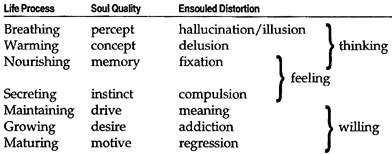
Sense of Ego
Sense of Thought
Sense of Word
Sense of Hearing breathing
Sense of Warmth warming
Sense of Sight nourishment
Sense of Taste secreting
Sense of Smell maintaining
Sense of Balance growing
Sense of Movement maturing
Sense of Life
Sense of Touch
What happens to a person in whom the life processes become too
conscious, in whom the astral body works too consciously? If the astral body
works too deeply in the etheric, the life processes become over-ensouled.
In artistic work, Steiner describes how a certain ensoulment of life
processes takes place and is healthy; when listening to music and seeing art
this also happens. If this ensoulment is too strong, there arises almost a
"second" person who "pseudo" thinks, "pseudo"
feels and "pseudo" wills.
Konig points out that we can recognize this in many of our children with
special needs: "it" thinks in them. Steiner describes how a sort of
thinking, feeling and willing then appear within us, but these have a different
quality, a more life-filled quality; the thinking, feeling and willing have a
more dream-like quality not guided by the ego.
We can again recognize many special needs children in this description:
something "wills" in them or "thinks" through them.
Here follows a diagram with the life processes. It identifies the effect
of each on the healthy soul and points to the effect each produces if too
overensouled.
Ether-types:
warmth-ether effect: Orig.
chemical ether: Thlas.
earth aspect of ether: Querc.
light-ether: Mill.
Urt-d. has all 4 ether-types united in it:
the life-ether in the lignifying quadrilateral stem,
the chemical ether in the typical metabolic processes in the leaf,
the light-ether in the sharply-indented leaves,
the warmth-ether (among others) in the exploding seed of the flowers.
Frei nach:
Kevin Maker
Represents the work of generations. What becomes readily apparent on
reading the book is that the writer is a man whose whole life has been steeped in
anthroposophical thought, experience and influences. The very fabric of
Steiner's vision, with all of its eclectic wonder and complexity, has so woven
itself into the pattern of Husemann's writing that he and Steiner seem to speak
as one voice. There are times when it seems as if it is Steiner who is
elucidating and the multi-layered complexities which are being presented by
Husemann. The book is so rich in content and ambition that even the most
seasoned anthroposophical physician might have a hard time digesting its
contents in one sitting.
Husemann informs us in the preface that the cohesion of the book is
derived from its focus on three modeling exercises which Steiner gave to young
doctors in order to "train their understanding of the life processes on an
Imaginative level“.
This focus is aimed at solving the following problem: if we cannot see
the etheric body or the astral body, how can we justify our practice of
anthroposophical medicine whose focus in on that which most of us are unable to
perceive objectively? Husemann's answer is to allow the subjective into the
realm of science, and this is justified by a philosophical perspective which
places subject and object equally within the phenomenology of thinking.
One gains access to the astral, etheric and "I," in which one
lives, through the practice of art. Sculpture gives us access to the etheric,
music to the astral, and the "I" becomes accessible in language. By
artistic exercises and explorations, such as sculpting the organs in modeling
exercises according to Goethean archetypal forms, one can verify Steiner's
perceptions of the etheric, astral and "I" in the deeper states of
one's own being. It is the
elaboration of these artistic exercises and explorations that makes up
the remainder of the book.
The high quality of scholarship in the book is evidenced by
extensive footnotes. Husemann provides us with detailed information from the
fields of physiology, comparative anatomy, pathology, human anatomy and
embryology, as well as many elucidating examples from the realms of
sculpture, music and poetry. This erudition is complemented by Husemann's
thorough familiarity with current anthroposophical thought and with Steiner's
writings in relation to the subjects under discussion.
The book is divided into four parts which build on each other and
lead the reader from the physical to the etheric and on to the astral and the
"I," from sculpture to music and on to eurythmy and language. Basic
concepts are presented in part one: a sculptural conception of organ formation
is presented in light of plant and animal forces; the sculptural exercise of
limb formation is presented and growth discussed in relation to musical laws.
Part two pre- sents the modeling exercise of inversion and explores its musical
structure. Parts one and two use sculptural exercises and the quality of the
musical interval to investigate vital organic processes externally in the limb
and internally in the organs. Part three investigates respiration and the
mediation between the external processes in the limbs and the internal organ
processes. Part four presents a discussion of eurythmy as musical structure and
leads to a concluding examination of language.
A fascinating section in part two explores the significance of artistic
exercises in the cognition of Goethe and Haeckel. Using numerous quotes from
Steiner, Husemann shows how Haeckel used drawings similar to those in
ancient Egyptian mystery schools to arrive at the idea of the gastraea.
For Steiner, the gastraea represented the animal archetype counterpart to
Goethe's plant archetype; yet Haeckel, stuck in the materialism of his
thinking,
was unable to recognize the archetypal significance of his own
perceptions. Steiner places Haeckel's work "in the epistemological context
of Goethe's methodology“. This discussion of Steiner's relationship to the work
of
Goethe and Haeckel provides valuable insight into the development of
anthroposophical thought.
American osteopaths will find interest in Husemann's discussion of
cerebrospinal fluid. Anthroposophical osteopaths, who have been telling us that
craniosacral treatments draw them close to perceptions of the etheric, will
find support in Husemann's statement: "Every artistic, every
thought experience arises because respiration intercepts, in the cerebrospinal
fluid, the motion of the ethericbody“.
Comparative anatomists will enjoy following Husemann's description of
his father's research in the development of the clavicle throughout the animal
kingdom. The bone's great variation of form as depicted as the large,
elegant and bow-like structure in the storm petrel contrasted with the
tiny, square blocks that are found in the mole.
The graphics in the book are startlingly well chosen. The static Apollo
of Tenea from the archaic period of Greek sculpture is used to illustrate what
happens musically in the tonic prime feeling: "I rest my weight on my
feet“.
One sees how the legs of the statue carry the weight of the body like
pillars resting in prime position. Then Husemann illustrates the musical
movement from the prime to the second feeling: "I carry the weight of my
lower
leg and foot“. He uses Doryphoros by Polycletus from the Greek classical
period as a sculptural representative of the musical second. We see in this
statue how it is imparted with life and a fuller humanity as the free leg lifts
and induces movement throughout the whole body. The graphics serve to
enhance our under- standing of Husemann's discussion of music.
Husemann realizes the difficulty of discussing certain musical concepts
on the printed page and urges the reader to listen to the pieces to which he
refers: Bruckner's Seventh Symphony; Mozart's Piano Sonata K.545; Chopin's
Etude Op. 10, No. 12; a Hopi Indian lullaby and much more. What a
wonder-inducing approach to the study of medicine!
Husemann's book makes a timely appearance in English translation.
Harmony of the Human Body deals directly with core issues of anthroposophical
medical education at a time when we are making the first gestures toward
formalizing such education in America. The Anthroposophical Medical Education
Seminar, which took place in November 1995 in California, included modeling
exercises of human organs and eurythmy exercises. The book
is already exerting its influence.
Husemann reminds us in his postscript that personal training in
Anthroposophy should lead to the practical implementation of Anthroposophy in
the life of society. Never has the need been greater to revitalize the spirit
of medicine. The pressures of managed care and algorithms of care strive to
intrude in all our practices. The large insurance companies and market forces,
which have taken over our profession, steadily attempt to reduce the
practice of medicine to the bottom dollar desolation of a business.
Husemann's book is a welcome aid to all physicians who sense the wrongness of
the present situation and seek to awaken within themselves the spiritual
forces which should guide our lives and our profession.
‡ Folgendes hat anthroposofische Einschlüße ‡
Frei nach: James Dyson, M.D.
If we
go back to the early 1920's when Steiner was beginning to develop his medical
work, medicine stood at a crossroads. A few years after Steiner gave his
medical lectures, insulin and vitamin B12 were discovered. Shortly
after
that, in the early 1930's, the sulfonamides were developed; then followed
antibiotics during the Second World War, and in the 1950's there followed the
main impact of psychiatric medication, which has transformed the management of
a great deal of mental illness. I am referring particularly to the major
tranquilizers, the anticonvulsive drugs, the antidepressants, and so on. At the
time when Rudolf Steiner was speaking, manipulation of the bodily basis of much
that we would now call mental functioning had not even started, yet at that
time psychoanalysis had already made a beginning.
Freud's
work was becoming established, and it wasn't long before the work of Carl Jung
came into the foreground. Steiner had major reservations about psychoanalysis,
but it is important for us to understand what these were
based
on. He did not, for instance, deny the validity of the concept of the
unconscious. He stressed, however, that without an understanding of the
spiritual nature of the human being, including reincarnation and karma, and
without
an understanding of how substances in the body really support the life of soul,
any attempt to penetrate into the sphere of the so-called
"unconscious" or "subconscious" would be fraught with
misunderstanding.
He
stressed that any attempt to penetrate this realm would involve an awareness of
the threshold between what belongs essentially to the soul-spiritual nature of
the human being as it has evolved over many incarnations and
the
everyday conscious experience of the self. This corresponds to the threshold
between the point-centered consciousness of our earthly, waking ego and the
peripheral consciousness of our life of will. Although an awareness
of the
existence of an "unconscious" had surfaced during the early part of
this century, its interpretation - without a basis in spiritual scientific
training and understanding - was, in Steiner's view, at best misleading and at
worst dangerous. He was particularly concerned with some of the more
specifically sexual interpretations which dominated Freudian methods at the
beginning and which, in his view, had already created many illusory
interpretations.
Steiner
gave a particular insight with respect to our understanding of mental illness
which redresses the one-sidedness of the psychoanalytical approach. He
emphasized that one must first understand the bodily basis of the soul
life
before trying to interpret what comes to expression in the soul as such.
Alongside this statement he suggested that, with respect to the nature of
organic physical illness, one should search for its origin more in the realm of
the
soul and spirit.
You can
see how he was both anticipating and countering a trend that was to increase in
momentum during the following decades, a trend which to this day dominates
current thinking as strongly as ever. I am referring to the
trend
to separate our understanding of the human being into a biochemical model on
the one hand and a psychotherapeutic, psychoanalytic model on the other - the
former without reference to the soul and spirit, the latter
without
reference to the actual bodily basis of consciousness. It might seem that
Steiner was anticipating the biological basis of psychiatry in pointing to
bodily dysfunction as underlying much mental illness. He was speaking
from a
very different perspective from that which has since evolved and given rise to
the current "psychopharmaca". He was challenging us to see
physiological processes and substance transformations within the body as the
basis
or expression of the soul-spiritual element while at the same time seeing
soul-spiritual processes as being accompanied on some level by physiological
ones. I would say that the central challenge of the anthroposophical
contribution to psychiatry lies just in this: to bring together the realm of
creative spirit with an understanding substance and metabolism.
This is
a challenge which has not yet fulfilled its potential although very encouraging
and exciting beginnings have certainly been made. Behind this, there lies the
deeper challenge of understanding the nature of matter or substance in its
soul-spiritual aspect. This is, of course, the challenge of anthroposophical
medicine. The part which belongs specifically to psychiatry is to see how the
substances and processes which these substances undergo
in the
organs are connected to possible deviations or aberrations of consciousness,
which psychiatry describes and attempts to address.
Steiner
describes two streams of time. The one which we are aware of in our everyday
consciousness goes from the present into the future. The other stream works in
the opposite direction and comes from the future into the present. These two
streams of time, the former connected more to the conscious astral body, the
latter more to the etheric, meet within the human being. They meet in the realm
of the ego, which is the only instrument of consciousness that can really
integrate past and future, thereby bringing the destiny that we bring with us
from former incarnations into the freedom- space from which new impulses may be
born.
Much
mental and soul confusion arises in the encounter between these two streams of
time, even some forms of mental illness may arise from this. The
substance-processes taking place in our organs contain within them the
seeds
for our future consciousness. If these seeds are released prematurely from
their etheric basis in the organic life and enter consciousness too soon, they
will produce delusion, deception, hallucination, fear, anxiety, mania.
All possible
forms of soul aberrations may come about through the tendency for the etheric
forces within the organs to rush forward into the future too soon. On the other
hand, when the forces working from the past bind us
too
strongly to our organs, then tendencies to hardening and sclerosis take hold of
the body. We become locked into our earthly personalities, and therein lies the
basis for the more characteristic physical illnesses. In the
healthy
human being, the latter processes predominate in waking life and the former
during sleep. During waking life, the etheric up-building processes in our
organs become subordinate to the more conscious experiences of
soul
life and vice versa. The two streams of time also oscillate between our waking
experience and our sleeping, hence the possibility for dreams with prophetic
overtones.
Most of
us know that Waldorf education emphasizes the fact that the organic forces,
which build the body during the first seven years and which also belong more to
the state of sleep, become released to some extent at the age
of
seven. In fact, they only become released from the head and nerve- sense
organization, where they become available after this time for thinking and
memory. The etheric substance which has formed and shaped this part of
our
body is the same substance through which, at a later stage of development, we
are able to think. We must imagine that this is only the first of many etheric
metamorphoses that may take place during the course of life. The etheric forces
that release themselves for thinking belong essentially to the instrument of
the brain. The brain is an organ whose development proceeds faster than any
other organ; by the time we are seven, it has reached a
certain
completion. We call this stage neurological maturity which is witnessed, for
example, in the establishment of dominance and in nerve myalination in the
central nervous system through which the basic pathways of
sensory
integration are laid. We also know that the actual nerve cells in the brain, from
before the time we are born, have been slowly dying and degenerating. In fact,
degenerative processes accompany our brain and nerve
sense
system during the course of our life. This is the corollary of the fact that
our brain and nerve- sense system form, for the most part, the basis of waking
day consciousness.
This
"slow death" of the physical body in the brain is that which allows
the etheric forces, which formed and sculptured it and which contributed to its
organic development, to be used for conscious thinking activity. With the
other
organs, however, this process does not take place to the same extent. If we
consider an organ which stands in a certain polarity to the brain, namely the
spleen, we find an organ which hardly appears to be a physical organ
at all.
In contrast to the brain it lacks internal form and structure. Also, unlike the
brain, it is an organ which is continually regenerating itself. If we consider
the spleen, however, we have an organ which carries within itself the basis not
of our self-conscious image memory but of our substance memory.
In the
modern world, we call substance memory the science of immunology. In recent
years, the importance of our physiological uniqueness in the form of our
immunological memory has become almost general knowledge. Without it we are
unable to maintain our identity against the outside world. The spleen can be
removed without apparent detriment to health, although, in a child, its loss
leaves some degree of compromised immunity, depending amongst other things on
the age when this happens. It is an organ with a kind of peripheral sphere of
activity. I am referring to the millions of smaller lymph nodes throughout the
body which have a kind of satellite function in relation to the spleen itself, but
which can exist independently after the foundations of immunity have been
acquired.
We are
dependent not only on our image memory for an earthly biography but on our
substance memory too, although it is not so immediately obvious why this is the
case. Animals, for example, do not have individually- based immunological
specificity. Immunological identity belongs more to the species. Animals,
however, do not have individual biographies. The animal's identity is
"species-based," not "specimen-based“. In recent years,
immunology has become threatened as never before. Indeed, it is no longer
something which can be taken for granted.
Without
our brain, we would not know who we were when we woke up in the morning;
without this, earthly consciousness would be chaotic as, indeed, it becomes in
certain conditions of cerebral degeneration. If image memory
is
connected with the brain and substance memory with the spleen and immune
system, must it not follow that our image memory is the basis of our waking-day
consciousness of self and our substance memory the basis of our sleeping or
unconscious self? This may be identified with our true individuality or
higher-self working and weaving between incarnations.
From
this perspective, it is perhaps possible to make the connection between
individual human immunity and personal karma although I am aware that this may
appear as a big jump to make. Our normal habits of thought would lead us to
assume that metabolism proceeds in its own way and that we meet our karma from
a completely different realm in a somewhat metaphysical manner. I strongly
suspect, however, that this is another trick of dualistic thinking. We meet the
outside world in essentially three ways: through the portal of the senses, the
portal of the breath and the portal of metabolism. In all three, substance is
involved: in the metabolism, the connection is very obvious; in the breath, we
meet the substance of air; and through the senses, we meet light. Just as in
our metabolism we first have to break down and digest what we eat before it is
rebuilt, a similar process must also take place in our senses. Our entire
nerve-sense organization has the characteristic that it first has to hold back
sense impressions and digest them, as it were, before they can become integrated
and internalized in the life of soul. The processes of sensory digestion and
substance digestion are working together all the time, continually playing into
one another. It is quite clear that we meet our destiny and karma from that
which we encounter via our senses. What we have breathed in and digested
through our senses unites itself inwardly with that stream of substance which
has first been broken down in our digestive organs. In this way, individual
destiny becomes imprinted within the very substance of our bodies. Can you
sense how the normal boundaries of logic, which separate substance from spirit,
begin to disappear. The dualistic distinction between these two realms is not
quite so clear. Ahrimanic forces have taken hold of the material realm, and are
continually trying to widen the gap between their realm and the realm of
creative spiritual being. On the other hand, however, the substances we eat
have been created by photosynthesis from the light. The substances of earth and
light essentially belong together, although these two concepts have become
mutually estranged.
During
the time of our embryonic development and, to a lesser extent, throughout our
childhood, the substance-building processes of our body are at their most
creative. The child's unconscious life of will is working with those very
etheric forces which will later develop into forces of consciousness. At the
beginning of life, these forces are involved in the forming of the sense organs
themselves, which become built and inter-connected like resonance chambers,
through which what is received from the outside world can take shape within
bodily substance. The etheric processes whereby this happens have been called
by Steiner the life processes. The eye, with a lens and so forth, is the most
obvious example of a sense organ. Mediated by the eye, an interaction takes
place between that which comes toward it from the outside world in the form of
outer light and that which we bring toward the perception from inner
experience.
In theory,
we can imagine that we first experience the light as a pure sense perception or
percept. However, for a human being a pure percept can scarcely exist. The
moment the outer world impinges upon any sense organ, it is taken up and
"digested" by inner processes working on a more or less unconscious
level. Contrary to theories of ordinary sensory psychology, which attribute
everything of a cognitive nature to the nerves, these are connected to
processes in the blood which carries the element of will.
Through
this digestion of the percept in its encounter with blood- processes there
arises an entire spectrum of possibilities of soul life. Broadly speaking, the
life element of the blood brings the instinct and drive towards the percept,
and between these two poles there arises everything connected with concept,
memory, feeling and judgment. The formation of a concept in relation to a
percept, already involves a degree of judgment. Against this backdrop we can
see that the seven life-processes actively transform what, to begin with, came
toward us as a purely outer phenomenon into something internalized and
incorporated into the sphere of soul and body. This process which is most
active in the developmental period of embryonic life and childhood is, of
course, liable to all manner of aberrations through, for ecample, sensory
deprivation or overstimulation. If a child meets inconsistent behavior or even
frank abuse, the judgment-forming processes of the soul will be impaired. The
earlier this takes place, the more deeply rooted will be the aberrant forms and
structural developments in the body arising from it.
The
bodily basis for the future life of soul depends intimately on how the
life-processes interact with the sense organs, particularly during the
developmental stage. It is also through this process that the adult
relationship between the etheric and the astral bodies is slowly established in
the organs. In fact, the character of this relationship is distinct for each
organ - and organs are just as much sense organs as they are metabolic ones. In
this way the developmental basis is established for much that later on
expresses itself in the form of psychiatric illness.
I will
have to assume for the moment that what Steiner has described about the seven
life processes is not entirely unfamiliar to you. They are connected, of
course, to the seven planets, which Steiner has also described as having a
connection to the seven main internal organs. During the course of embryonic
and child development, the astral forces, which belong to the planetary realm,
and the etheric forces work very closely together. Through the particular
affinity between the organ and the planet, a kind of resonance chamber arises
in the body for each of the seven planetary spheres which, when taken together,
comprise the entire astral body. The moon sphere, which is most closely
connected with the earth, forms the brain. The Saturn sphere, which is the most
removed from the earth, forms the spleen. The Jupiter sphere and the Mars
sphere work together in the formation of liver and gall bladder. Mercury works
into the lung and Venus into the kidney. The planetary forces working within
each organ help the etheric forces of the organ to remain held and integrated
in the body. They bring boundaries to bear on the otherwise expansive
tendencies of the etheric body. During the developmental period, the
relationship between the etheric body and the astral body is laid down in the
organs themselves. Astral forces have more of an affinity to connect with the
sense impressions from the outside world, in relation to which they then unfold
as faculties of soul. As I have said, each organ is in fact just as much a
sense organ as it is a metabolic organ. In the brain we see an organ whose
substance comes closest to death - thereby it is particularly suited to forming
the basis of waking consciousness. In the spleen we see the opposite processes
at work. Here the blood processes, which belong to the very depths of our
unconscious life of will, have taken hold of everything coming from the outside
world and metamorphosed it into bodily substance. In the brain, the forces of
the outer world, i.e., the sense impressions, become dominant and the astral
body and the etheric body both withdraw from the physical body after creating
their most complex imprint within it. This may be seen in the language of
modern brain physiology in terms of the complex network of nerve growth
factors, which are activated only to the extent that the child's life of will
is aroused to a creative relationship to sense perceptions. Perhaps we are
seeing in these processes what Steiner has described in referring to a
co-operation between blood and nerve processes. After the imprint has been
created they become emancipated from the body, thereby becoming free for the
conscious life of soul. In the brain the outer world is always in danger of
conquering the inner world; that is to say, through the brain we lose touch
with our inner being.
In the
spleen, however, we can say the opposite, namely that the inner forces of self
are continually triumphing over the forces of the outer world. The astral and
etheric bodies remain active metabolically in the blood pro- cesses and the
spleen therefore retains a strong connection to the unconscious ego which remains
active in the body directly rather than via the kind of structural imprint
which is to be found in the brain. We may therefore say that the way the life
processes take hold of these two organs expresses a polarity.
Between
the spleen and the brain we find the inner organs of the liver and the lung. In
the lung we see an organ which is, in many ways, similar to the brain. It has a
very strong and hard endoskeleton in the form of its bronchial tree, composed
of cartilaginous rings. Steiner has characterized the lung as having the
closest relationship of all the organs to earthly thoughts - that is to say, to
the brain. Steiner connects the lung, for instance, to the ability to memorize
facts and figures, quantity rather than quality, for example, telephone
directory memories. He describes all our memories as being imprinted into the
etheric sheath or etheric surface of our organs - and the actual etheric forces
through which the lung has been formed have a particular affinity to earthly
thoughts, to everything that lends itself to being weighed, measured and
quantified. Steiner has called this aspect of our etheric body, the life ether.
These life ether forces which work on a bodily level in a kind of additive way,
as is expressed, for example, in the continuous growth pattern of a fungus,
these life ether forces in the lung become something like the guardians of
those sense perceptions which belong to the essentially earthly element of
cognition based on factual memory.
We are
all very familiar with various clinical ways in which this comes to expression.
For the curative teacher, for example, the child will come to mind who can
sometimes quite literally remember every single detail of everything that has
happened, not only today and the day before, but perhaps last week, last month,
last year, or even ten years ago. Some children display remark- able
encyclopedic memories of this kind.
We see
a similar phenomenon, albeit in a different form, in the adult who displays
obsessive tendencies or fixed ideas. In a fixed idea a spiritual happening
becomes de-contextualized - it is made into something of an isolated entity.
The way the ether body works in the lung is continually appealing to this kind
of isolating, fixating tendency. The forces of the outer world are therefore
not being so thoroughly internalized, digested and metamorphosed into fantasy
as they are in other organs, for instance, the liver. The outer world imposes
itself on the soul in too direct a form - hence we can say that in the lung, as
in the brain, the outer forces are, relatively speaking, conquering the inner
forces.
Just as
the lung stands in an intimate relation to the brain and the nerve- sense
system, in so far as it isolates the individual elements from the whole being, making
a kind of self-contained entity from them, so the liver, in contrast, is an
organ which cooperates very closely with the spleen in the whole system of
metabolism. Just as the sense organs all converge on the brain, where the sense
impressions become metabolized within the life of soul, so does the intestinal
tract converge in the liver, through which substances from the outside world
begin to be elaborated into the unique substances of our own bodies.
This
substance-building activity of the liver, when imbued with the impulses from
the spleen, also forms the bodily basis of our will life, but it exerts its
influence a little closer to the level of the soul than does the spleen. If the
spleen is the guardian of our pre-earthly intentions, then the liver is already
attempting to bring these to manifestation here and now on this side of the
threshold. It is the organ which gives the bodily basis for the exercising of
initiative and motivation, it is the origin of our vitality and, to some extent
also, our enthusiasm. All these soul functions are intimately connected with
the way metabolic processes interface with what is taken in from our senses. It
is possible, indeed up to a point normal, for cognitive life, which has
developed itself on the basis of our sense perceptions, to follow a different
direction to the life of deeper motivation or intentionality. Without the
tension that arises between these two realms, both connected as they are to our
life of will, but in very different ways, we would not find the power to pursue
our earthly biography from a condition of inner freedom. However, it is
possible for the normal healthy tension that should exist between these two
realms to diverge to such a degree that the seeds are planted for a real split
between the cognitive world and the world of more unconscious will life. This
may manifest itself fairly quickly in some form of depression or inability to
put intention into deed, or be delayed by years, decades or even life-times!
Liver physiology is in turn connected with the biliary system. Secretory
processes of the liver are focused in the production of bile, which is stored
in the gall bladder before being ejected into the intestines. Here it
encounters substances from the outside world and contributes to their
breakdown. Biliary processes are even more strongly connected to the more
conscious pole of will than is the liver. The liver stands at a kind of mid
point between the biliary processes, through which our will encounters the
outside world, and the spleen, which is the guardian of the deeper nature of
the will. Any obstruction or congestion in the process of bile production or
excretion may have a laming effect on the conscious life of the will and this
may be often observed in medical and psychiatric practice if one is awake to
this possibility.
The
liver is an organ with a strong kinship to the fluid realm. If the substances
of the outer world overwhelm the liver, then it becomes something like a
stagnant pool of water. Substances are taken in, but are not vitalized and may
sit there heavily, as it were undigested or impenetrated. When substances are
incompletely digested, allergies may arise. Classical allergies are fairly easy
to identify but nowadays one meets an increasing number of a more insidious
variety which may manifest only through more subtle symptoms such as tiredness
after eating, loss of vitality and so on. This tendency is often exacerbated in
a clinical depression, or in someone with chronic fatigue syndrome, where a
vicious circle of interactions is often seen.
You may
remember the very famous example from Steiner's Curative Education Course of
the child who has difficulty with his will in actually stepping into a tram.
Sterner connects this description of a child who is, as it were, paralyzed in
his will, who is unable to release himself from the conscious life of thought
into the spontaneity of a deed, to a weakness in the activity of the liver. He
actually suggests that the disorder may have been inherited. Whenever weakness
of will manifests itself in the child or adult in any form, we can ask
ourselves if the liver - or for that matter the gall bladder - is in need of
support. This sometimes shows itself at times of transition in life, for
instance, in the menopause or following a pregnancy. At both these
transition-times a person is increasingly vulnerable to suffering from
depression. During the menopause, a further metamorphosis of organic etheric
forces into the conscious soul life is taking place - or at least the potential
is there for this to happen. Forces which have been active on a bodily level in
the glands until this time become available for new soul-spiritual activity or
development. If they are not appropriately taken up, however, congestion of the
liver and biliary system may ensue. Indeed, moderate degrees of this are almost
normal at such times, since processes of metamorphosis are usually only
gradually accomplished.
On a
more day by day level, we also experience physiological transitions at three
o'clock in the morning and three o'clock in the afternoon. At three o'clock in
the afternoon, blood sugar levels are usually on the low side, signifying that
the substance building aspect of liver function is at its weakest at this time.
At three o'clock in the morning, however, bile production is at its weakest
point. Both these times of transition tend to be difficult periods during the
day or night for people struggling with depressive illnesses. Waking at three
o'clock in the morning with morbid thoughts - that is to say, thoughts which it
is not possible to properly digest and integrate into the waking consciousness,
are very familiar examples of this. In more severe forms of manic depressive
illness, tendencies of this kind can be much more dramatic.
Steiner
has connected the liver with that part of the etheric body which is called the
chemical ether. This is also sometimes called the tone ether, the number ether
or the sound ether. Through this ether, physical growth is inwardly organized
according to the inner harmonies of number and measure, which also become
manifest in the inner harmonies of music. When this etheric quality becomes
prematurely released into the realm of soul, the stream of time coming from the
future to the present is likely to overwhelm the normal state of waking
consciousness. All manner of experiences can then arise to which the soul feels
connected but no longer in a free way. Such things as ideas of reference, deja
vu phenomena, and even deeper states of paranoia, may thereby arise. The
etheric forces which are particularly connected with the liver give us the
experience of becoming contextualized in our environment. When these forces
unfold their activity too strongly in consciousness, a disturbance in our
relationship to the surrounding environment may ensue. Paranoia is one of the
most frequent forms that such as disturbance takes. One feels threatened by the
environment, but in a very personalized way, almost as though the substances of
the outside world are working their own life out at our own expense! Paranoia
may, in turn, be a fairly transient phenomenon, with a more neurotic character,
or it may be major symptom of a severe psychotic depression, or even a
schizophrenic illness.
I
mentioned a few moments ago that an astral quality from one or other of the
planetary spheres works together with the etheric body of a particular organ,
constraining these forces and guarding against their tendency to jump, as it
were, too quickly out of the body, too quickly into the future. Whenever that
planetary or astral activity within an organ becomes weakened - and weaknesses
may be inherent or acquired - the soul becomes vulnerable to encountering
forces from the etheric body which it should not meet until after death or
until one is suitably prepared for a conscious encounter with the spiritual
world. Any drug or poison will also to some degree deflect the life-processes
from their bodily manifestation, leading to the premature release of etheric
forces into the soul realm. This phenomenon forms the basis for the
anthroposophical understanding of certain aspects of drug abuse. Different
drugs may display certain organ affinities - for instance, the qualitative
effects of cocaine may be seen in terms of the lung, of LSD more in terms of
the kidney. What one is then meeting as a disturbance of the etheric forces of
the organs is also a disturbance on the life-processes of the organs. It is a
kind of foretaste of the experience that we meet after death, when we see the
panorama of the life that we have just lived. After death this experience -
known as the etheric tableau experience - normally only happens when our entire
ether body becomes freed from our physical body. At the time of our death this
experience is strongly held within the sphere of the Being of Christ and the
Spirit of the Guardian of the Threshold. If this happens prematurely, albeit
only in a modified form through a drug, the soul may experience later
difficulties or impediments in returning properly into the body and this may
also sow the seed for different forms of disorientation and dislocation of the
conscious life of will. I cannot expand in this talk on the theme of drug abuse
or addiction. I would, however, like to point to the close connection that has
often been noted between certain drug experiences and certain spiritual
experiences. This becomes much more readily comprehensible when we are able to
understand it in terms of the organs. The forces that are released from the
etheric activities of the organs, the forces more bound up with the inner side
of the life processes, are expressions of the living activity of spiritual
beings that are still active within the substance of our own body. The
threshold to the substance-building processes is indeed the same as the
threshold to the spiritual world altogether. We meet the spiritual world where
the substance-building processes of our bodily organs are taking place. But it
is quite a different thing to meet this through a process of inner training and
inner development, or to meet it after death when these forces have been
naturally released, so to speak, than it is to do so through substance abuse or
through weaknesses within the activity of the planetary sphere belonging to a
particular organ. For the anthroposophical doctor and psychiatrist, the field
of possible medicinal therapy opens up at this point through, for example, an
understanding of the connections between the different metals, the planets and
the organs. It is not possible to develop this further, however, at this point.
I hope
that this broad overview serves to indicate how Anthroposophy spans so many
aspects of the realm of psychiatry, opening up new possibilities of
understanding, of diagnosis and also of therapy. I have also tried to point out
the extent to which the realm of psychiatry and the realm of inner development
or initiation are intimately connected. I have often had the feeling that much
that is met in the realm of psychiatry may be a kind of result or expression of
an uncompleted process of initiation in a former life. I would certainly not
suggest that this is so in every case, but an insufficiently prepared
initiation may be the result of an attempt to cross the threshold into the
spiritual world too soon. We see the same gesture becoming manifest when our
etheric body in the one or other of our organs wishes to become released too
quickly. Thoughts such as this are sometimes helpful in those cases of mental
illness in which it is not possible to discern their origin in this life on
earth, and with which a person may have to live for a whole incarnation.
It is,
however, often possible to understand a great deal of mental illness or
psychological disturbance in relation to childhood development. Nowadays
childhood development is under threat and it is very difficult for most people
to go through childhood in such a way that they achieve a healthy
soul-spiritual penetration of the body. Many things are responsible for this,
including poor nutrition, an education that has no respect for phases of bodily
development and which already draws organic processes too soon from the body
into the realm of soul; through a general deprivation of what Steiner has
called the bodily senses - that is to say, the senses of touch, life, movement
and balance. When the life processes withdraw from these senses too quickly,
the astral body is not able to create a sufficiently strong resonance chamber
or imprint for itself within the physical and etheric bodies. This may show
itself in later life in the form of soul insecurities, anxieties, hyperactivity
and so on. Childhood is also threatened through the general dissolution of
society. Conventional securities, accepted modes of behavior, and so on, are
rightly falling to one side, but all too often parents are not able to replace
them from their own individual resources. We continually find ourselves thrown
back upon ourselves, needing to rely on personal judgments too soon before the
organic basis of our body has been properly equipped to fulfill this task. This
crumbling of the social and moral fabric of society throws the developing child
all too easily into a state of turmoil. At an increasingly early age the
adolescent has often to encounter the sense of inner void, meaninglessness, the
realm of inner darkness. Existential questions to do with self-identity
confront the adolescent nowadays almost as a normal phenomenon, whereas even 30
years ago the securities that applied to generation after generation acted as a
form of protection against this.
When we
really meet the existential question, "Who am I?", the answer never
can be found in the outside world which we meet via our senses. It can only be
found from that same eternal self which lives behind the threshold of our
physical organs. Between our conscious experience of self and our eternal
being, however, there lies that interface of soul which I mentioned a few
minutes ago - the realm in which there is an ongoing battle between our
conscious self and our eternal self. The bodily basis of our life often looks
for ease, comfort and security. Spiritual intentions on the other hand threaten
earthly securities, and deep-seated fears, doubts and so on may be evoked by
them in the soul. These forces belong to those instincts and, to some degree
necessary, egoistic drives which are implanted within our physical body and
which work into our earthly personality at a deeply unconscious level. These
forces are constantly enticing us to build our identity on the outside world -
on something upon which we can apparently rely and from which we can derive a
certain sense of security and predictability. Everything that derives from the
outside world and which we meet through our senses - particularly those aspects
to which the lung has an affinity, such as obsessions., fixed ideas and so on - all these will tend to offer us apparent
solutions in the face of the spiritual challenge in meeting the inner void.
In so
many of the psychiatric illnesses of adolescence, we see particularly clearly
how this phenomenon comes to expression prematurely. I refer, for instance, to
the phenomenon of anorexia, which has almost become a kind of epidemic at the
present time.
In more
recent years psychiatry has developed a new interest in the personality,
particularly through the descriptions of so-called multiple personality
disorders - now referred to as dissociative identity disorders. In this type of
condition the tension between opposing elements is no longer held or integrated
within the framework of the single person, but different elements become seeds
around which apparently independent personalities develop. There is sometimes a
lack of continuity of ego consciousness and even memory between the one
personality and the other - a fragmentation has taken place. The more severe
forms of this disturbance are usually connected with sexual abuse during early
life. I am sure that through deepening our understanding of the co-operation of
the senses and life processes during the time of childhood development, our
insights into this type of disturbance would take on new dimensions. In fact, a
number of anthroposophical psychiatrists have already begun to do just this.
As many
of us are aware, however, this phenomenon can lead to some of the most
frightening of phenomena which we as human beings may have to encounter. When
an ego fragmentation takes place, islands of our etheric and astral bodies have
become dislocated from the overall sphere of the ego organization. It is here
that the borderline between the realm of medicine and psychiatry on the one
hand and that of social and personal morality, becomes almost
indistinguishable. Those of you who are familiar with the works of Scott Peck,
particularly his book "People of the Lie", will be aware that he
addresses this problem. He challenges contemporary psychiatry to build a new
scientific understanding of the realm of evil, stressing how until the present
time this realm has been considered to fall outside the scope of science. This
book was not written with dissociative identity disorders particularly in mind,
but I am sure that there is a close connection between these phenomena and many
of his descriptions. He relates much of what he has to say to possession - a
concept which, until recently, was considered to be virtually medieval. I think
that this book by Scott Peck is a clear example of the condition that modern
psychiatry finds itself in, when it attempts to confront the spiritual nature
of the human being. I believe his book is courageous and, in many ways, quite
masterly. However, it struggles without having any way of connecting the realm
of substance with the realm of the spirit. And, as I began my talk by saying, I
think that it is just this potential that is unique to the anthroposophical
contribution to psychiatry. The original polarity between substance and
creative spirit arose during the time of the Fall on Old Lemuria. From this
time onwards the creative world of the spirit and the actual substantial
happenings in matter started to separate. We are now at the point in human
evolution when out of their own nature these two forces will continue to
diverge ever more and more strongly. Steiner forecast that by the end of the
century we would be blighted by epidemics of mental illness of one kind or
another - and I am sure that amongst other things anorexic disturbances and
dissociative disorders are among the examples that could be cited to bear out
his prediction. I believe that ultimately the task of mental illness is to
stimulate in us the call to inner development, to truly know ourselves. Whereas
up until the present time we had a certain license to decide not to follow this
path, it is nowadays almost imperative to do so if we are to confront and deal
with problems, if not exactly in epidemic, then certainly in escalating
proportions. Modes of being that were once regarded as extreme pathologies
become ever more and more common. Unless a sufficiently strong impulse is
ignited in humankind to hear this call, then this separation between substance
and spirit will continue. It will then become increasingly difficult for human
bodies to sustain a basis for integrated ego consciousness into the future.
They then become the basis for the activity of those evil beings - so called
"anti-spirits" of personality to which Steiner has given the name of
"Asuras“. The loss of immunological identity that we are also witnessing
at the present time is, I beheve, the mirror image of this. That is to say, it
is the polar expression of the same phenomenon. In the realm of psychiatry, the
possibility of the conscious ego to integrate itself with its own karma is
threatened, and at the level of immunology, the possibility for the unconscious
organization of the ego to penetrate physical substance is also threatened.
This theme is obviously one with which we could occupy ourselves not only in
coming days, but also in the coming decades and centuries. We live in a time
when developments are accelerating around us, but this was something that
Rudolf Steiner anticipated at the beginning of this century and which
Anthroposophy is intended to help us to master. We are, however, still only at
the beginning of doing just this - it lies in the hands of each of us to help
to realize this aim.
I'd like to end with the second half of R.S.'s mantram from the Course
for Young Doctors
I will unite
The Knowledge of my soul
With Fire of the flower's fragrance;
I will bestir
The Life of my Soul
On the glistening drop of leafy morning;
I will make strong
The Being of my Soul
With the all hardening Salt
Whereby the Earth with loving care
Nurtures the root.
‡ Folgendes hat anthroposofische Einschlüße ‡
Frei nach: Armin Scheffler, Ph.D.
„Zum Verstaendnis der Morgen- und Abendprozesse und ihrer Anwendung in der Heilmittelherstellung“.
In a lecture given on 25 November 1917,(1) R.S. spoke of the need to use
morning and evening processes in pharmaceutics in the near future.
Two other processes in the cosmic order went against this. He called
them the midday and midnight processes and characterized them as follows: the
midday processes were mainly brought to bear from the Anglo-American sphere,
the midnight processes from an eastern direction. Morning and evening
processes, which always could work together, represented the Christian impulse.
They were opposed with a kind of Antichrist from the West, whereas the streams
coming from the East would try to prevent true perception of the Christ
impulse. R.S. also related certain cosmic activities, designated by signs of
the zodiac, with the three kinds of processes. Morning and evening processes
were said to be due to the cosmic activity of Fishes and Virgin; noon processes
were in the cosmic direction of the Twins; and midnight processes were forces
coming from the Archer.
R.S.'s actual words were:
For a regular professor of biology it is of real importance today to
have a microscope with maximum possible magnification, the best possible
laboratory methods, and so on. In future, when science will have become
spiritual, it will be a question of whether certain processes are best done in
the morning and evening or at noon; if one lets the evening forces influence
whatever has been done in the morning or if one excludes, it paralyzes the
cosmic influence from morning to evening. Such processes will prove to be
necessary in future, and they will take place... People with knowledge of the
cosmos will fight each other, with some of them bringing morning and evening
processes to bear in the way I have indicated; in the West preferably the noon
processes, eliminating morning and evening processes, and in the East the
midnight processes. Substances will no longer be produced merely according to
chemical attraction and repulsion, and people will know that a different
substance results if one uses morning and evening, midday or midnight
processes... Nothing can go wrong if the power coming from the Fishes and those
coming from theVirgin act together... .
These words may sound strange, but they have found application within
the anthroposophic movement. Anthroposophic medicines are produced by
rhythmical methods based on R.S.'s statements. Procedures such as gentle
heating, exposure to light, or setting the mixture in motion are applied to the
plant preparations in the mornings and evenings. If we ask ourselves if this is
really in accord with what R.S. indicated in the lecture on 25 November 1917,
one objection arises that can scarcely be invalidated: the fact that it is
perfectly possible to treat a plant preparation in the mornings only, for the
method used does not make it necessary to treat it also in the evening. R.S.
made it clear, however, that morning processes absolutely demand to be combined
with evening processes and that it is impossible to separate the two.
To get a clearer picture, let us consider the context of the lecture.
During World War I, R.S. frequently drew attention to the fact that people live
with the dead in a very real way. Shortly after the passage quoted above, he
said:
We can only see them (things) as they are if we are able to apply the
concepts and ideas of our anthroposophically-oriented science of the spirit to
the real world. The dead will have a major role to play for the rest of the
Earth's existence, and it will be a question of how they do this. Above all,
the big difference will be that the attitude of people who are on Earth goes in
a positive direction and the dead can then be involved at a point where the
impulse to act comes from them, where it is taken from the world of the spirit
which the dead experience after death.
Speaking to the dead
One way in which R.S. showed the connection with the dead began with a
reference to the different levels of consciousness in our thinking, feeling and
will activity: waking, dreaming, sleeping. If we consider the two extremes of
consciousness, we are citizens of two worlds. In waking consciousness we live
with the three realms of nature and with the human beings who are born, in
sleep consciousness with the spirits of the hierarchies and with the dead. In a
lecture given on 5 February 1918, he said:
Anyone who gets to know the life which the human soul has between death
and rebirth... will see that in this world, in which we move in our sleep, we
live together with the so-called dead. The dead are always present. They are
present in a supersensible world, moving within it and relating to it. We are
not separate from them in terms of being real or not, we are separate from them
only in our state of consciousness. We are separated from them exactly the way
we are separated from the objects surrounding us when we are asleep: sleeping
in a room, we do not see the chairs and other objects that may be there, though
they are definitely there. In our so-called waking state we are asleep in our
feelings and will, right in the midst of the so-called dead - only we do not
refer to it as such - just as we do not perceive the physical objects that
surround us in our sleep.
He then said with great emphasis: "This knowledge of being with the
dead will be one of the most important elements which the science of the spirit
must implant in general human culture for the future“.
Surely this means that Anthroposophy has the task of making this
knowledge part of general education so that everyone will find it as natural as
eating and drinking. The question arises, however, as to how we can recognize
the real connection with our own dead. How does the nature of our experiences
change when we move from sensory awareness to awareness of the world of spirit,
that is, on crossing the threshold? R.S. described this with reference to human
dialogue. In the world of the senses, the situation is like this:
Let me be specific. If you talk to someone else here in the world of the
senses, you talk, and the other replies. You know you produce words with the
aid of your organs of speech; the words come from your thoughts. You feel you
are creating the words you speak. You know you hear yourself speak, and when
the other person speaks you hear him, knowing that you are silent and hearing
the other person... Dialogue with the dead is experience in the opposite way:
communion with the disembodied souls is not like this. Strange as it may seem,
communion with disembodied souls is exactly the reverse. When you communicate
your own thoughts to the disembodied soul it is not you who speaks but he. It
is exactly as if you were talking to someone, and anything you wish to think
and communicate is said not by you but by the other person. And the replies
given by the so-called dead person do not come to you from outside but rise up
inside you; you experience them as your inner life. This is something one must
first get used to in clairvoyant consciousness.
We can get an inkling of the different quality of dialogue if we pay
real attention to the other person. A situation may then arise where we forget
ourselves and enter wholly into the individual nature and thinking of that
other person. This may also happen with objects that are part of our
professional life. Working with a medicinal plant, for instance, we may become
absorbed in careful observation of phenomena and go to sleep with reference to
ourselves, awaking in the object.
Noting questions - evening processes
Processing flowering male mistletoe plants harvested in Winter to make an
aqueous preparation, we always noted a sticky, resinous material adhering to
the surfaces of the tools used to mince the mistletoe material. It could only
be removed with benzene, which is a fat solvent. Production of this resinous
matter was all the greater the more froth developed on mincing the mistletoe.
However carefully we worked, it proved impossible to prevent this resinous
material separating out. A second, similar phenomenon was the following: when
the berries, which contain gum, had to be processed to make an aqueous
preparation, they took up plenty of water, but the gum did not completely
dissolve. This was seen on filtration: a jelly-like layer formed on the filter
which only let a few more drops pass, finally clogging the filter completely.
It is easy to ignore this and carry on as before. Thus, one tolerates
the separation of the resinous substance and, in the other case, simply does
not make a full berry preparation. Yet if processing mistletoe to produce a
medicine really matters to us, the question arises: how can I prevent the loss
of this resinous material and what significance does the production of this
material have in our understanding of the mistletoe plant?
You become aware that it is not you who asks the questions but that they
arise when you consider the phenomenon with wonder and awe. It is as if you see
or hear the question. It is important to take this as seriously as a question
asked by a revered friend. R.S. always spoke of these two stages on the
schooling path: noting the question and taking it seriously. He spoke of
developing the inner life by taking the path of reverence. Elsewhere, he
referred to both steps. The first step - here described as becoming aware of
questions - was called wonder and awe" and the second step reverence,
which is taking the question seriously. Reverence is followed by the feeling
that a spiritual entity has made itself known. On the schooling path, it is
part of this stage to distinguish the important from the unimportant.
Everyone may make many such observations in the course of a day, and
they may show themselves to be questions when we do our nightly review. As a
rule, however, we tend to go to sleep over them. In the lecture of 5 February
1918,6 R.S. said that as we go to sleep we put hundreds of questions to the
older people among the dead with whom we have a connection. They have had a
long life in the world of the senses and now experience the soul aspect of its
situations. This makes them open to questions. R.S. put it like this:
The strange thing is that the moment of going to sleep is particularly
good for putting questions to the dead, thai is, for hearing the question we
put to the dead person come from him... The older souls among the dead draw us
more to themselves, whereas the souls of those who died young tend to draw
nearer to us. Because of this we have much to say to the older souls, and we
can create a bond with the world of the spirit by addressing ourselves to the
older souls among the dead at the moment of going to sleep. Human beings can
readily do quite a bit in this direction.
Experiencing answers - morning processes
It has already been said in this quote that we receive the answers from
different dead persons, from younger ones, who give us impulses as we wake up.
We tend not to notice this very much for the life of the senses, which is then
beginning, tends to blot those answers out. Another reason why people do not
find it easy to enter into communion with the dead is that if we perceive the
answers at all, we take them to be something that comes from ourselves and not
something for which the dead have given the impulses. Again, let me quote R.S.:
When we lose children, when young people leave this world, it is
essentially true that they do not really leave us but remain with us. This is
apparent to clairvoyant consciousness from the fact that the messages which
come to us as we wake up are very lively if the dead are children or young
people who have died. A connection exists between those who remain behind and
the dead, and it would be fair to say that a child or young person is not
really lost to us; they actually remain. They remain mainly because, after
death, they have a lively need to influence our waking up, sending messages as
we are in the process. It is truly strange, but it is true, that someone who
has died young has an extraordinarily great deal to do with everything
connected with the waking up process.
The following example may be said to come close to those experiences.
Working with mistletoe (its morphology, biology and material qualities) and
realizing that the gums, being hydrophilic and dissolving easily in water, are
the opposite of the hydrophobic, water-repellent, resinous substances, which
are more inclined to relate to air, we decided temporarily to abandon our
attempts to process extracts of flowering and berry-bearing mistletoe
separately and, instead, process the two together. The experience (of deciding)
had been as if someone looking over one's shoulder were saying: "Simply
try using the berries together with the flowering mistletoe and its resinous
material“. Everyday routine would, however, prevail and the suggestion be
forgotten. Yet when we noted resinous matter separating out once again, the
challenge came again: "Go on, try; make the experiment.“.. Four months
later, the experiment was made, adding different proportions of berries to
flowering male Winter mistletoe material.
The 25% addition gave the most convincing results. No resinous matter
was deposited on our tools as we minced the mistletoe and incorporated it in
the aqueous solution. To everyone's surprise, the extract was much easier to
filter than any we had worked with before. No fat layer remained on the filter,
and the filtered extract was a deep, dark green, indicating that a good proportion
of fatty types of substances had also been taken up into the aqueous solution.
Chlorophyll, the green leaf pigment, is fat soluble and embedded in fat-like
membranes. These now became part of the extract and could be seen as a fine,
milky clouding if a bright light shone on the extract from the side.
The outcome of the experiment revealed the character, or idea, of
mistletoe in a way that moved us deeply. Years of intensive botanical work had
shown one major character trait of mistletoe to be that it always allows
opposites to interact to the effect of producing an embryonic, inhibited state.
Here, we had the gesture: the fat-soluble, resinous matter, wanting to escape
from the water into the air, combined with the heavy gum from the berries that would
not dissolve properly and a slightly cloudy, milky solution was obtained. We
might call it a resin/gum colloid (Greek colla = glue). It was as if mistletoe
nature itself had provided the answer.
R.S. spoke of two more steps that follow wonder and reverence: feeling
at one with the laws of the world and devotion“. The first is necessary to
prevent us from acting on anything that comes into our heads, the second to
enable us to work selflessly for the object. Wonder and reverence are, thus,
connected with putting the question, being at one with cosmic laws; and
devotion with receiving the answer and acting on it.
What does this have to do with morning and evening processes? Is it not
a matter of crossing the threshold in two ways, hearing the question as we go
from the world of the senses to that of the spirit and experiencing the answers
as we return from world of spirit to world of senses? Rhythmic alternation of
the two processes is a necessary consequence for we cannot go to sleep several
times without waking up in between, nor can we wake up several times without
going to sleep in between. Morning and evening processes, therefore, always go
together.
Mercurial processes mediate the polarity between light-related flowering
impulses and earth-related root powers.
Midnight processes
The next question is: are there corresponding midday and midnight
processes? We find these in the different attitudes the seeking human being has
to the two worlds. To seek, for instance, is to develop an interest in which the
soul connects with something outside it. In the world of the senses we have to
give ourselves completely to the object, leaving self aside as we direct our
attention to it. This ideal of genuine science may also be called selfless
love, a love which has its origin in the beloved nature of something that is
utterly different. Our seeking is, however, entirely different where the world
of the spirit is concerned; but this love for things of the spirit must be
on our own account. Our roots are in the world of the spirit. It behooves us to
make ourselves as perfect as possible. We must love the world of the spirit for
ourselves, bringing as many powers as we possibly can from that world into our
own essential being, m our love of the spirit this personal, individual element
- we might call it an element of egotistical love - is fully justified for it
tears us away from the world of the senses, taking us up into the world of the
spirit. It helps us to do what is necessary, which is to make ourselves more
and more perfect.
R.S. said it was most important to master the process of moving to and
fro between the two worlds. The danger that the change does not take an orderly
course may take two forms. On one hand, the seeker may achieve transition to
the world of the spirit without first cleansing himself of affects and
passions. Luciferic spirits may, then, take hold of him causing his inner life
of feeling to be torn away from the world of the senses so that he develops his
own illusory world. Such people tend to have pet ideas and rapturous idealisms;
they become philosophizing eccentrics. Vanity, ambition and the desire for
power are particular qualities that tend to be overlooked when human beings
should have come to know themselves before crossing the threshold. A feeling
may develop that the state of soul they have known in the world of the spirit
should continue forever.
Another, even greater danger is connected with this. The circumstances
of life in our time are such that they prevent knowledge of the higher world.
If someone nevertheless has desire for higher knowledge, then, according to
R.S., the following may happen:
If the human being brings impulses into the world of the senses which,
in the world of the spirit, may take him to the most sublime experiences, they
may have the most abominable effect... the kind of love that is justifiable
only in the world of the spirit then enters into sensual drives, passions,
desires, and so on, making them perverse. The perversities of sensual drives,
all the abominable abnormalities of those drives, are the counter image of
sublime virtues that could be achieved in the world of the spirit if the
powers, which now pour into the physical work, were to be used in the world of
the spirit.
The reason for this human attitude is that validity is given only to an
attitude that belongs to the world of the spirit. This is the world of sleep,
and processes of this kind may, therefore, be said to be midnight processes.
Midday processes
R.S. described the second great danger in his lecture on 25 August 1913.
The attitude of mind which belongs to the world of the senses is also applied
where images from the world of the spirit are concerned. He referred to this as
"nibbling at goodies in the world of the spirit":
It is possible, therefore, to nibble at goodies in the world of the
spirit; it then frequently happens that something experienced in that world is
taken into the world of the senses. There, however, it condenses and contracts.
A clairvoyant who, thus, does not follow the laws of the general order of the
universe will then return to the physical world of the senses with condensed
images and impressions of the higher worlds so that he is not merely seeing and
thinking things in the physical world but has the after effects of the other
world before him in images as he lives in his physical body. These are very
similar to the images perceived through the senses but do not relate to
reality; they are illusions, hallucinations and daydreams.
Later in that same lecture he said:
Those nibbled goodies from the world of the spirit are the special prey
of Ahriman. Ordinary human thoughts provide him only with airy shadows; but -
to put it in ordinary words - he gets rich, dense phantom shadows by squeezing,
to the best of his ability, from individual human bodies the false, illusory
images that have arisen through nibbling at the goodies of the other world. The
result is that the physical world is filled in an ahrimanic way with spiritual
phantom shadows that go disastrously against the general laws of the general
order of the universe.
Many of the ideas people have today concerning electricity and magnetism
and also physiological processes are such phantom shadows. These enable people to
intervene in the physical world to a degree that has never before been
possible. The evil that goes against the order of the universe lies not in
knowing the world of matter but in such knowledge becoming tainted with
egotistical drives and desire for power.
The tendency to make spiritual contents materialistic even applies to
important human ideals. Three such ideals have been ours for centuries. Goethe
called them "god, virtue and immortality“.1 If we are able to see and
admire the divine element in the whole of creation, we are, in the Goethean
sense, monists. In Christian terms, this is "God the Father“. The second
ideal, that of virtue, points to an attitude of lovingly encompassing anything
"other“, seeing the process of becoming in all that has come into
existence. The third ideal, that of immortality, means knowing of repeated
lives on earth, knowing that the spiritual core of the human being moves
rhythmically to and fro between the physical and the non-physical worlds.
Today, those three ideals have become materialistic, which is only too
evident if we read the greetings sent to people on their birthdays. It is hoped
they'll have riches and prosperity, gold, in short, and also good health and a
long life. God thus becomes gold, virtue health, and immortality long life.
Spiritual contents have been made part of the world of the senses. The inner
attitude is particularly common in our western world, and we may equate it with
the midday processes.
Consequences in pharmaceutical research
Our inner attitudes are a major influence in the world for they change
the realm of matter. Environmental problems are one example, but the
manufacture of medicines is also affected. Above, an attempt was made to show,
from the example of mistletoe processing, that the application of morning and
evening processes influences even the way in which substances combine.
If "midnight processes“ ideas, are used at fantasy level,
correction is missing that can be made if our observation and perception
include wonder and awe, that is, the experience of questions. Other qualities
are abstracted. The conviction that one is doing the best thing possible
prevents objective perception of the consequences of one's actions.
"Midday processes“, on the other hand, will only allow materialistic
ideals to have validity. A typical example can be given from recent mistletoe
research. The isolation and description of mistletoe lectins, the most
important group of mistletoe poisons, has caused many scientists to believe the
antitumor activity of mistletoe to be due to those lectins. This does, of
course, have an effect on the manufacture of mistletoe preparations, and
preparations of isolated mistletoe lectins are now available and put to
clinical use.
Ahriman is the force who wants to tie human beings to the world of the
senses and who always speaks the truth but brings falsehood into the order of
the universe by presenting only part of the truth. It is only part of the truth
to say that lectins are important active principles. Mistletoe can only be a
cancer medicine if those lectins are combined with the other substances in a
way that is not possible for the plant itself but which is entirely in accord
with its general developmental gesture.
For this, we must enter into "real dialogue" with the plant so
that, as pharmacists, we become mediators between the two worlds. Polar worlds
come alive in us in regular rhythm if we hear the older, dead souls communicate
the questions that have arisen in the course of the day as we go to sleep and
experience the answers as impulses to act coming from the younger dead on
waking in the morning. This may well be the way the morning and evening
processes of which we have spoken may be understood.
The inner questions and answers may also be connected with astrological
terms, as R.S. did in his lecture on 25 November 1917. This would not be a
matter of external, physical influences from parts of the cosmos being brought
to bear on the pharmaceutical process without involvement of the human being.
Quite the contrary, it suggests that the activities of the cosmos must be
looked for in the spiritual and in the sensory experiences of the human beings
who take an active part in the process. This throws light on R.S.'s statement
that physical and chemical laws are mainly operative when substances are
combined or separated today. In future human activity will increasingly
influence the way in which substances are combined or separated.18 To emphasize
the importance of this human involvement, with all the need for constant practice
and exercises, we conclude with a warning R.S. gave in his lecture on 25
November 1917:
Today, no more can be done than to talk of these things until people
have sufficiently understood, that is, people who are prepared to accept them
in a selfless way. Many think they can do this; but there are many factors in
life today which prevent it, factors that can only be properly overcome if,
first of all, we gain increasingly deeper understanding and actually refrain,
at least for the time being, from immediately applying these truths on a
relatively large scale.
Frei nach: Lueder Jachens, M.D., Arno Triebkom, M.D.
R.S. spoke of the differentiation of the general ether into warmth
ether, light ether, chemical ether and life ether. The human experience of
seeing in the light is the outstanding aspect of the light ether. However, both
light and warmth ethers not only act through external light and heat but, for
instance, also influence human beings through local climatic conditions
throughout the year. In the case of the chemical ether we realize that the
ether forces are always in polar opposition to the forces active in physical
matter. Chemical analysis thus leaves behind an ether body consisting of
synthesized ether forces. The life ether enlivens unenlivened matter.
In modern science it is impossible to think of an action that does not
have a physical source. On the other hand, matter dissolves into energetic
states if analysis is taken far enough; here the general approach used today
takes us to the limits of knowledge. Ether activities come in centripetally
from the periphery. Matter forms at the center; its actions are centrifugal.
Chemical ether activity is revealed in the analytically-determined
"bio-chemical pathways". A law becomes apparent: highly complex
physical processes are based on simple spiritual forces; an uncomplicated
physical body has a highly differentiated spiritual creator. Elsewhere Rudolf
Steiner considered the question as to whether in spiritual terms chemical
analysis relates to homeopathic potentization at a spiritual level, with
external separation into parts resulting in a concentration of activity in the
diluent.
R.S.: the ether creates an image in the fluid, watery part of the human
head, which makes the head permeable to the ether. Thus the eye is a creation
of the light ether and permeable to it. The head is mainly permeable to the
higher ethers which ray in from all directions. From there, the light ether
pours into the organism and organizes the whole human being. Humans take in the
lower ethers from the earth sphere through metabolism and limbs. From there
they ray upward in the human being, towards the higher ethers. Both kinds of
ether must be kept distinct in an orderly way in all parts of the organism.
The skin as an organ arises from the interaction of the two kinds of
ethers. As a sense organ the skin provides entry for warmth and light ethers
coming from the periphery; it is created and shaped by the digested higher
ether, which has passed through the organism, and built up by the lower ether
streaming up from below. Established is advanced age and life-long high-level
exposure to UV light as the major risk factors for basal cell and squamous cell
carcinoma, with sebum secretion and susceptibility to skin inflammation playing
a secondary role. Individuals with greasy skin and a history of acne were less
likely to develop these cancers. If the organism is able, therefore, to oppose
strong light with sufficient lower ether, the higher ethers are less likely to
erupt through the boundary, resulting in tumor development. A healthy skin can
be seen to be a well-balanced organ that will immediately signal predominance
of higher or lower ethers. Work done elsewhere has indicated that individuals
on a low-fat diet show a lower incidence of actinic keratosis. The fact that a
diet rich in animal proteins and fats encourages sclerosis also relates to
this. Nutrition provides an example of external activities (diet) taking effect
inside (intestine to liver to skin), sunlight an example of external activities
taking effect on the outside (skin).
Sunlight activity differs in summer and winter. Summer sun provides us
with both higher ether and the lower ether of the earth's ether body which
extends beyond the earth's surface; neurodermatitis and psoriasis may heal.
Winter sun brings the higher ethers "naked" to the human periphery;
this is apparent in desiccated eczematous conditions. The effect of the light
ether in sunlight can be seen in the skins of country and seafaring people, which
is dry and strongly formed out. Polar activity is openly displayed: light ether
expands to infinity, physical skin principles contract. The different effects
of alpine and marine climates on humans can be understood if we consider the
different relationship between the ethers. The higher ethers dominate at higher
altitudes, producing a stimulating climate. By the sea, the lower ethers are
also powerful; a seaside climate is calming, making people tired and increasing
their appetite. The relationship of St John's wort to light is evident from its
medicinal actions: taken internally it helps with winter depressions (lack of
light in the soul sphere); used externally, with the oil applied to the
fontanel, it is helpful in treating rickets (lack of light in the physical
sphere).
Ether is taken up into the human organism, the lower ethers mainly via
foods and the intestine, the higher ethers mainly through the senses. Both
kinds must be equally well digested and made our own. Thus external light must
be transformed into inner light which gives form and shape in the organic
sphere and "brightens" the soul sphere. At heart, people's hunger for
light today is doubtless a longing for the inner light of higher perception.
Sunlight tolerance changes depending on whether someone sleeps, stands, walks
or actually works in the sun. The more active the person, the less the harmful
effect of the sun; the action of the I within the organism is also different in
each given case.
R.S.: disorganized actions of the ethers leading to the polar morbid
tendencies of malnutrition and softening of the brain. Excessive activity of
the higher ethers leads to poisoning and rigidity; excessive activity of the
lower ethers to softening, dissolution.
This provides flexible concepts for the general morbid tendencies at the
functional level that underlie a specific dermatosis without actually
determining it. The tendency to malnutrition would thus be underlying
neurodermatitis, the tendency to softening of the brain, wet eczema, acne and psoriasis.
Softening of the brain is an image for pathological extension of digestive
activity "in the direction of the head". Here we think of all the
dermatoses of people with reduced digestive powers in whom digestion and
elimination proceed via the skin, in the wrong place. Accompanying phenomena
such as migraine and postmenopausal hormone substitution also come under this
heading ("rejuvenation treatment"). In women the lower ethers are
more powerful, and they are more liable to develop urticaria, rosacea,
sarcoidosis, annular granuloma, lupus vulgaris and necrobiosis lipoidica than
men are. The higher ethers predominate in men who are more liable to develop
Hodgkin's disease of the skin, mycosis fungoides, hemochromatosis and
peripheral atherosclerotic disease. Faulty diet may have a negative effect on
the relationship between higher and lower ethers. Thus milk from farms with
pastures that have had an excess of nitrogenous fertilizer and dehorned cows
may cause the organism to be flooded with "lightless" protein in
which lower ether activities are dominant.
Bees are particularly open to warmth and light; honey, therefore,
provides excellent support for the higher ethers, especially in older people.
R.S.: differentiated, fluctuating interaction of the two types of ethers
as occurring in vortices. The human form arises from the vortical interaction
of the different ethers. Innumerable vortices are to be found in the human
organism. The hair lies in vortices in different skin areas. R.S. spoke of
these vortices as a center for lead-overcoming forces. Considering the
relationship between Saturn and the higher ethers, it is the lower ethers that
create the vortices. Atopic subjects often have a vortex on the forehead; on
the other hand many hyperkinetic children show numerous vortices in the hair on
the head. Blood is vorticed most strongly in the heart; the muscle fibers of
the heart runs in vortices.
After our work on the lecture, a pediatrician spoke of her clinical
experience with anthroposophic medicines in India. Vitamin A deficiency causes
children and adults suffering from malnutrition to have friable, vulnerable
skin. Walking barefoot and poor hygiene promote infections (scabies, bacteria
pyodermia, worms). Premature aging is common, and digestive powers are reduced,
as evident from bloated bellies and colorless stools due to protein deficiency.
On the other hand the children show remarkable enthusiasm and cheerfulness when
playing; they show patience and endurance, waiting for long periods in a disciplined
way. Children and adults are free from any intellectual braininess. Clinically
the enormous rapidity of recovery was remarkable when anthroposophic medicines
were used. The question arose whether malnutrition creates good conditions for
the action of potentized medicines and phytotherapeutic agents. With reduced
food intake, nutrition via the senses, the influence of the higher ethers,
becomes more powerful. The wide-awake ability to perceive quickly indicates
good digestion of sensory perceptions. Fluid intake is generally very low in
India. Parallels to the Schroth cure used in Germany, with reduced food intake
and both non-drinking and drinking days, come to mind. One reason for the
observed signs may be that digestion ties up energies in the lower human being.
The aim of digestion must be to remove all foreign nature from the food and
overcome the lower ethers taken in with it. Fasting, on the other hand, opens
body and soul to the cosmos; the higher aspects of the human being will then
respond better to treatment and treatment is able to support physiologic
homeopathization in the digestion more effectively. According to a statement
Rudolf Steiner made to one of his pupils, the poor quality of present-day foods
actually impedes spiritual development.
Der Wärmeorganismus des Menschen (Warm und Kalt)
Welche Bedeutung hat die Wärme im menschlichen Leib? Eine Antwort findet sich, wenn wir den Menschen unter einem bestimmten Aspekt betrachten: dem der vier Elemente.
Der Flüssigkeitsorganismus
Der menschliche Organismus besteht nicht hauptsächlich aus festen Substanzen, sondern zum größten Teil aus Körperflüssigkeit. Je nach Alter und Geschlecht sind 50 % bis 75 % des Körpergewichts durch Wasser bedingt. Dieses findet sich in ständiger Zirkulation in den verschiedenen Geweben des Körpers. Neben dem festen, mineralischen Leib gibt es also einen Flüssigkeitsorganismus, der nach eigenen Gesetzen gebildet ist.
Der Luftorganismus
Auch die Luft ist nicht nach dem Zufallsprinzip im Körper verteilt. Sie ist in bestimmten Organen wie den Lungenbläschen lebensnotwendig, in anderen Regionen wie dem Rippfell-Spalt geradezu gefährlich. Die Luft innerhalb des menschlichen Körpers folgt in ihrer Dynamik bestimmten Gesetzmäßigkeiten und bildet somit einen – wenn auch sehr beweglichen – Luftorganismus.
Der Wärmeorganismus
Für die menschliche Wärmeorganisation gelten ebenfalls bestimmte Gesetze. Eine konstante Temperatur ist notwendig für einen gesunden Ablauf der Körperfunktionen. Gleichzeitig sind die Wärmezustände
in den Körperregionen sehr fein differenziert. Das zeigt sehr gut eine Thermografie (s. Abb.). Um die notwendige Körperwärme aufrecht zu erhalten, wird zunächst im physikalischen Sinn Energie umgesetzt, so in der Verbrennung der Nahrungsstoffe und der Stoffwechseltätigkeit der inneren Organe. Über die Haut reguliert der Wärmeorganismus seinen Zustand. Bei Überhitzung (körperliche Aktivität/Fieber), wird die Hautdurchblutung erhöht und damit vermehrt Wärme abgestrahlt.
Durch die Schweißbildung entsteht zusätzlich Verdunstungskälte. Auch das zentrale Nervensystem beteiligt sich an der Wärmeregulation. Der Hypothalamus nimmt Signale über die Wärmeverhältnisse der Organe wahr und verarbeitet sie weiter. Der Wärmeorganismus ist der flüchtigste und dynamischste unter den vier beschriebenen Organisationsebenen mineralischer Leib, Flüssigkeits-, Luft- und Wärmeorganismus. Er bildet gewissermaßen die Brücke zwischen dem Geistigen des Menschen und seinem physischen Leib. In den verschiedenen Wärmezuständen spiegelt sich der Einfluss des menschlichen Willens.
Pflege für den Wärmeorganismus
Die „Pflege“ des Wärmeorganismus ist für die Gesundheit von nicht zu unterschätzender Bedeutung. Eine „Erkältung“ ist eine Verletzung des Wärmeorganismus, ähnlich wie ein Schlag dies für den Knochen oder den Muskel ist. Stabil ist der Wärmeorganismus dann, wenn er äußere Veränderungen der Wärme von innen heraus ausgleichen kann. Dringt äußere Kälte zum Beispiel so tief in den Nasen-Rachen-Raum ein, dass sie den ärmeorganismus überwältigt und die innere Wärme nicht ausreicht, die Schleimhäute vor der Kälte zu schützen, können „pathogene Keime“ leicht auftreten. Ein Infekt der oberen Luftwege ist die Folge.
Die eingewanderten Bakterien sind also nicht Ursache, sondern Folge der Erkältung. Ein plötzlicher kalter o. intensiver Wind kann ebenso die innere Wärmebildung lokal überfordern und Ohrenschmerz o.
Nervenreizungen auslösen.
Blauer Eisenhut meistert Wind und Kälte
Einen Schutz gegen Kälte kann der Blaue Eisenhut (Acon.) bilden, der dank seiner Herkunft vom rauen Bergland und oft schneidend kalten Höhen die Auseinandersetzung mit plötzlicher Kälte und Wind vorlebt. Eisenhut ist als potenziertes Arzneimittel hilfreich bei plötzlich auftretenden Störungen des Wärmeorganismus, rasch steigendem Fieber, plötzlichen Ohren- oder Nervenschmerzen.
In der anthroposophischen Medizin haben äußere Anwendungen eine besondere Bedeutung. Neuralgie gefährdete Menschen können sich durch Einreiben mit WALA Aconit Schmerzöl* vor Wind und Wetter schützen. Rheumatische oder verspannungsbedingte Muskelschmerzen lindert Aconit Schmerzöl schnell. WALA Aconit Ohrentropfen* helfen – frühzeitig gegeben – zuverlässig bei Ohrenschmerzen.
Viele akute und chronische Erkrankungen können wir durch einen bewussten Umgang mit der eigenen Körperwärme verhindern. Eine chronische Nasennebenhöhlenentzündung wird bei ständig kalten Füßen nur schwer zu heilen sein. Unzureichende Bekleidung kann chronische Blasen- und Nierenbeschwerden geradezu „heranzüchten“.
Das bedeutet auch, dass man Fieber bereits im Kindesalter zulassen und den Sinn von fieberhaften Kinderkrankheiten respektieren sollte. Gerade weil der Wärmeorganismus auch der Träger des geistigen Menschen ist, sollte uns seine Pflege besonders am Herzen liegen.
Vorwort/Suchen Zeichen/Abkürzungen Impressum